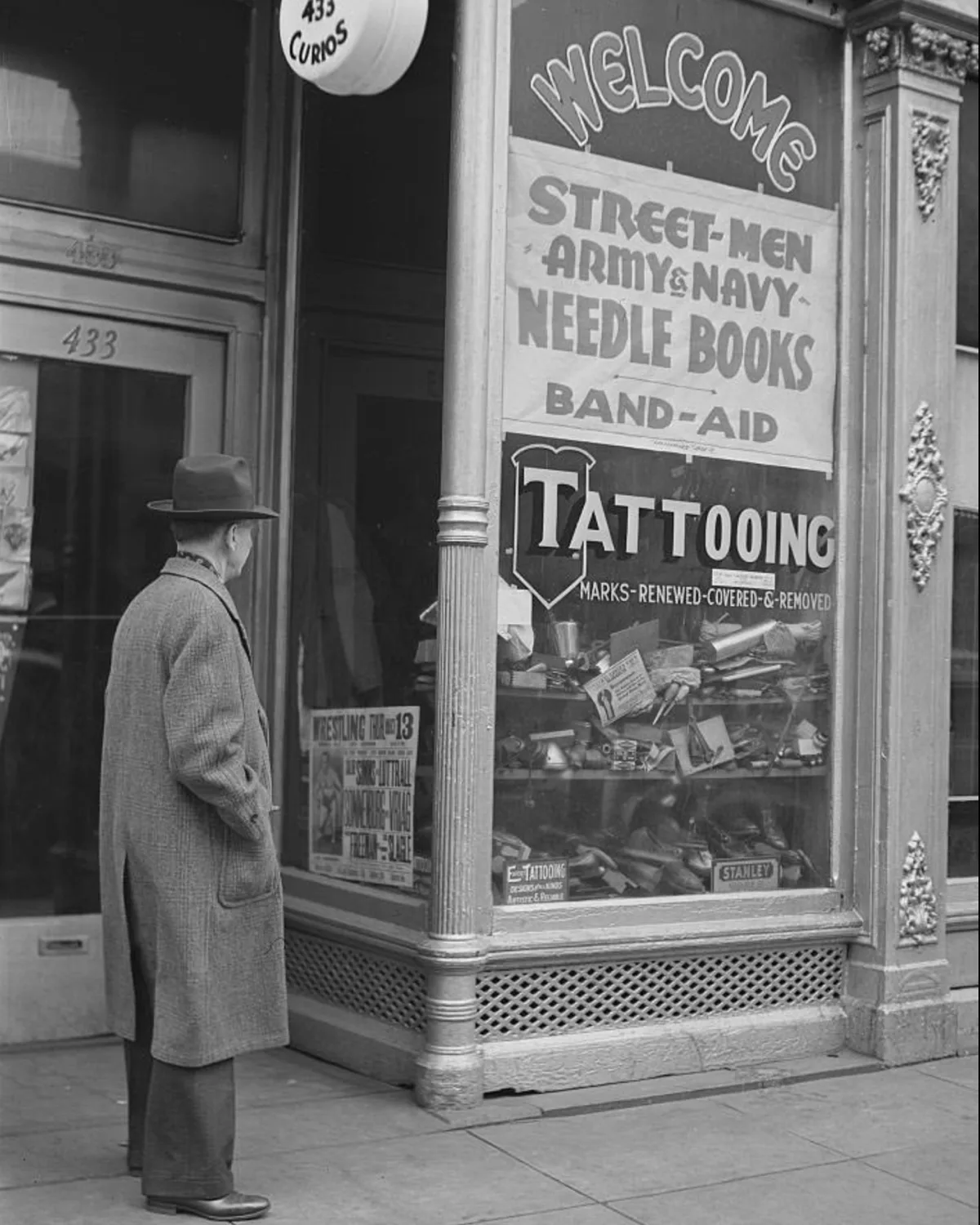
The standard Norfolk tattoo story starts in 1918 with Cap Coleman walking off a train and onto East Main Street. It’s a tidy story, and on Coleman himself it’s close: he came in with the Sheesley show in the winter of 1917. Where it goes wrong is the idea that tattooing started with him. The Norfolk city directory lists a working tattooer by 1904. What follows is the corrected history, sourced to primary documents where they exist and called out plainly where they do not. I wrote it for people who care about the long line of American tattoo practice, and for clients trying to make sense of where the work they are wearing actually comes from.
1. Before Coleman: Norfolk’s tattooers before 1917
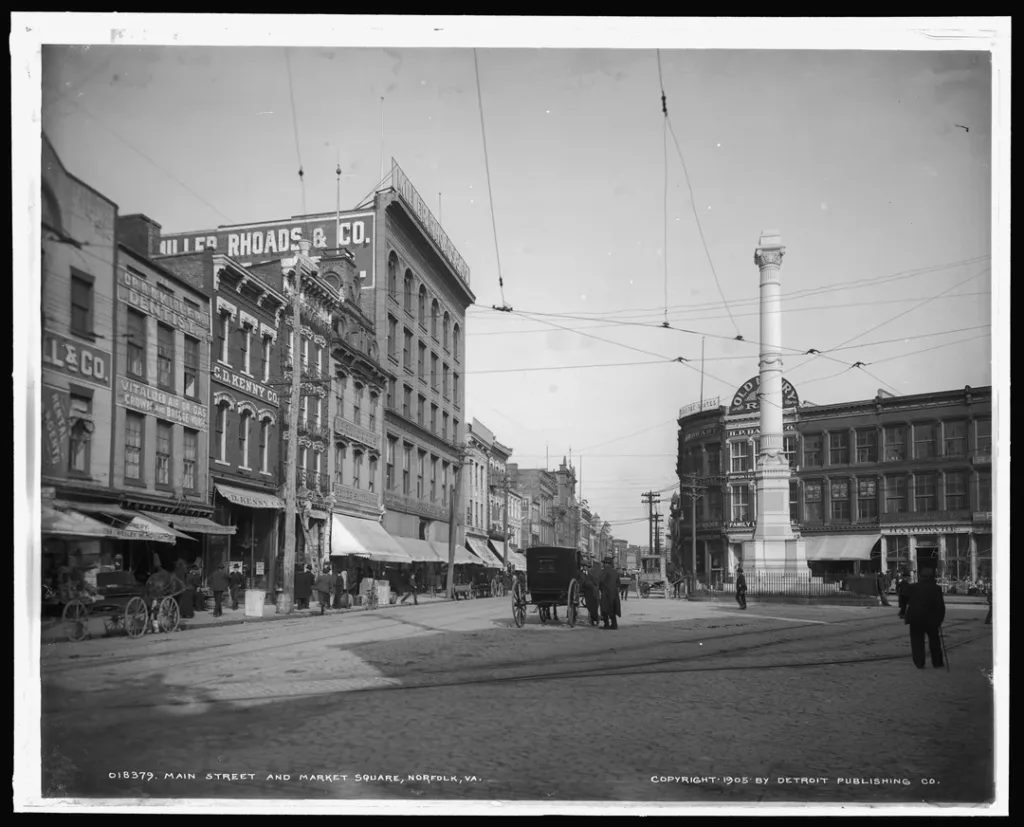
By the time Coleman showed up at the end of 1917, Norfolk had already been a sailor town for more than half a century. The city fell to Union forces on May 10, 1862 and stayed under federal control through the rest of the Civil War. The Gosport Navy Yard across the Elizabeth River in Portsmouth (today’s Norfolk Naval Shipyard) got rebuilt in the years right after and grew into one of the busiest naval facilities on the East Coast. From the 1870s through the Spanish-American War, the Norfolk waterfront ran on three currents of foot traffic: Royal Navy and merchant marine crews taking on coal and supplies, US Navy sailors on liberty, and the carnival and circus economy that wintered in Hampton Roads. Where sailors gather, tattoo work follows. Norfolk had the demand long before it had Coleman.
The Mariners’ Museum in Newport News acquired Coleman’s tattoo materials in 1936. Museum president Homer L. Ferguson’s June 8, 1936 letter, asking after tattoo instruments and a sheet of designs, called it a fading folk tradition: “nearly all the seagoing people had some kind of tattooing but it is rapidly becoming a dead art.”1 An October 26 follow-up called it “a marine art which is becoming more or less obsolete.” Ferguson was wrong about the obsolescence, as the next ninety years would prove. But the framing tells you what 1936 already understood: port tattooing was an established folk tradition with deep roots, not a novelty Coleman had brought to town. He grew up inside it.
The electric tattoo machine arrived through Samuel F. O’Reilly, who took out US Patent 464,801 on December 8, 1891 from his Chatham Square shop in lower Manhattan. The technology spread slowly. In April 1899 O’Reilly filed a bill of complaint against Elmer E. Getchell in the US Circuit Court for the Southern District of New York, alleging Getchell was selling knock-off versions of the patented machine.2 The case papers survive at the National Archives as USCC, SDNY, Equity Case File O-7211. The New York Times covered the dispute on February 6, 1900 under the headline “Tattoo Artist at War.”3
The name matters because Getchell keeps turning up in Norfolk. The 1897 directory lists an Elmer E. Getchell, artist, living on Bermuda Street. By 1901 the Tattoo Archive has Getchell working at 11 Chatham Square in New York, a few doors from O’Reilly, and leaving the city not long after. In 1907 the Norfolk directory has an E. E. Getchell tattooing at 138 Wolfe Street (it prints the first name as Edward). In 1914 it’s Elmer E. Getchell, tattooer, on Avon Street, and from 1918 into the early 1920s his shop is at 611 East Main.5 No single page says the Norfolk tattooer and the man O’Reilly took to court are the same person, so I won’t call it settled. But a Norfolk man named Elmer E. Getchell, working as an artist in 1897, missing from the Norfolk directories while the New York Getchell was fighting the patent case, and back in Norfolk tattooing by 1907, is about as close as the paper gets to saying it.
Eugene Jacob Miller, who went by E.J. Miller, often gets told as a pre-Coleman figure, but he came along after Coleman. He first shows up in the Norfolk directory in 1922 at 526 East Main Street, the storefront listed under Coleman’s name the year before. From there he was at 431 East Main by 1927 and 433 by 1935, running the Idle Hour Curio Shop and Tattoo Shop.6 A 1925 E.J. Miller tattoo supplies catalog from Norfolk has surfaced at auction. Paul Rogers mail-ordered his first kit from Miller around 1928.23 Period advertising for his supply business ran in Billboard and Police Gazette as early as 1924. He’s buried at Forest Lawn Cemetery in Norfolk, the same cemetery as Coleman and Lenora Platt.7

The men who were actually there first are in the directories. Sidney B. Wright is listed as a tattooer in 1904 and again in 1906. Winford J. Eldredge (the directory spells him a few ways) was tattooing at 138 Wolfe Street from 1908 through 1912. Simon P. Cole and James Wilson are listed as tattooers in 1914, and Wilson was still at it in 1918, by then at 429 East Main. That 1918 directory has three tattooers on East Main: Getchell at 611, Harry Lawson at 601 and Jim Wilson at 429. A year later Coleman and his partner Andrew Sturtz were working out of 429.5 Bill Grimshaw and Lenora Platt are documented elsewhere. Greenwood and Cleveland, both on the Tattoo Archive’s Main Street roster, don’t turn up in the directories I checked, and they’re still ghosts.
A fuller treatment of Miller and his East Main lives in a companion piece, E.J. Miller and Norfolk’s 1920s East Main Street. The pre-Coleman picture is simple to state. Norfolk did not become a tattoo town in 1918. By 1918 it had been a sailor town for at least half a century and had working tattooers in its city directory for fourteen years, and by 1920 tattoo supplies were being sold off Main Street by mail. Coleman became the most famous artist on East Main. He did not create the scene. He arrived into one.
2. The Coleman era, 1917 to 1950
August “Cap” Coleman’s working years on East Main Street are the period most people associate with Norfolk tattoo history, and for good reason. From the winter of 1917 through the 1950 city ban, his shop was the visible center of one of the best-documented American Traditional scenes in the country. His flash circulated through sailor networks across the Atlantic and Pacific fleets, his style fed forward into the broader American Traditional canon, and over three decades his shop hosted most of the other named figures in this corpus.

Coleman’s own account, printed in Billboard in 1930, is that he and his wife came to Norfolk with the Sheesley zoo “during the war days of 1917.” The paper backs him up. In January 1918 a Billboard letter from snowbound Norfolk reported, “Coleman, tattoo artist, is making pictures on the soldiers about here.”21 The 1919 directory lists Coleman & Sturtz, tattooing at 429 East Main, and by 1920 he was selling stencils and his own patented tubes in Billboard as Capt. A. B. Coleman.22 He moved around the strip for a few years (526 East Main in 1920, 405 in 1923, 819 in 1924) and settled at 427 East Main by 1925, where he stayed until the ban.5 By 1936 the Mariners’ Museum wanted his work.
Coleman’s partner on that first listing was Andy Sturtz (the Mariners’ Museum spells it Stuertz), and he came up the same road Coleman did. He was orphaned by six, and he was a poor kid in New York when Charlie Wagner tattooed him head to toe at 223½ Bowery. He toured as The Tattooed Boy with Gollmer Brothers, Hagenbeck-Wallace and Barnum & Bailey. That’s where he met Coleman, a tattooed attraction himself, and where he met Dagmar Hansen, a snake charmer from Copenhagen who worked as Maxine. When the novelty of his own tattoos wore off, he picked up the machine.25 He didn’t stay put. Sometime in the 1920s he was back in New York, working with Bob Wicks in the back room of a barber shop at 9 Chatham Square.26 By 1940 he had his own shop in Norfolk, and that June, facing a stay in the hospital, he sent a special delivery letter to Owen Jensen in San Diego asking him to come run it. Jensen came east and worked at Sturtz’s shop, and according to the Tattoo Archive, with Coleman too.27 After Dagmar died in 1945, Sturtz worked in his son-in-law’s jewelry shop. His granddaughter thinks he kept tattooing quietly, because he carried his flash with him. He died in 1962 and is buried at Forest Lawn, the same ground as Coleman.25
Lenora Platt was working East Main at the same time, in her own shop further up the street at 1015. The Tattoo Archive treats her as one of the central figures of the Norfolk scene, and she’s buried at Forest Lawn alongside Coleman and Miller. Her story is bigger than a footnote in someone else’s, and she gets her own piece at Lenora Platt: The Woman Behind Norfolk’s Tattoo Era.
Charlie Barrs worked with Coleman in Norfolk more than once. Most of the years went unrecorded, but one is on paper: in 1938 Owen Jensen, Barrs’s old partner from Los Angeles, came through Norfolk and found him there with Coleman and Sturtz.27 The Tattoo Archive entry on Barrs records that “Grimm stated that Coleman got in touch with Charlie Barrs and invited him to work with him in Norfolk. Apparently Coleman made Barrs an offer he couldn’t refuse: 100% of his take and free room and board.”8 That is not the offer you make to a junior. Yellow Beak Press sells a National Geographic photograph it describes as “the Coleman and Barrs shop front in Norfolk, VA circa 1939.”9 The date is the seller’s, but it fits a story Paul Rogers told: when the West Coast fleet came east for maneuvers, Barrs drove across the country to help Coleman tattoo the sailors, and made him take down every sheet priced at a quarter or fifty cents. After Barrs left Norfolk, the Archive notes, “Coleman’s tattooing looked like Charlie Barrs, only a bit heavier.” That sentence is small, and it deserves slow reading. Coleman’s style was absorbing Barrs’s technique. The influence ran both directions.
Barrs matters most for what happened at the very end. Shortly before the 1950 ban he came back east one more time, in his seventies, to work with Bill Grimshaw, two doors down from Coleman’s Place on East Main. Paul Rogers was working for Coleman then, and the Tattoo Archive records him crediting Barrs with his machine assembly and tuning. Eric Inksmith, Paul’s business partner years later in Jacksonville, Florida, adds that Paul gave Coleman the credit for everything he knew about machines (more in section 3). What Paul learned on East Main flowed forward into the late-twentieth-century American Traditional canon. The Norfolk scene was not just a high-volume production shop in the 1930s and 1940s. It was a technical school whose lessons got absorbed into the trade through the next two generations.
Coleman’s flash had a distinctive American Traditional vocabulary: bold black outlines, a limited classical palette, and a recurring set of compositional subjects from sailor culture and the broader popular imagination of the period. Dragons, geisha figures, panthers, eagles, hearts, daggers, ships, anchors, roses, all of it recurs across the surviving Coleman sheets and the period photography of his shop. A lot of those subjects, the dragons especially, came out of Japanese imagery as it moved through American sailor culture. It is worth being precise about what that means and what it does not. Coleman’s American Traditional flash used Japanese subjects as visual material. That is not the same as Japanese tradition. Japanese Irezumi is a distinct centuries-old practice with its own principles, its own compositional logic, and its own mentorship paths, rooted in Japan. The two streams cross-pollinated at the level of imagery in the early twentieth century. They are not the same tradition, and this page does not conflate them.

What Coleman did create, in a meaningful sense, was a high-volume American Traditional visual canon that traveled with the sailors who wore it. By the mid-1940s, that canon was being absorbed into the work of Paul Rogers, into the broader Atlantic and Pacific sailor scenes, and (through the catalogs and flash sheets Miller’s supply business helped circulate) into shops well beyond Norfolk.
3. The machine lineage: Coleman, Barrs, and Rogers

The full Norfolk machine-lineage story lives in a companion piece, How the Tattoo Machine Got Its Voice: Cap Coleman, Charlie Barrs, and the Norfolk Workshop That Shaped American Traditional. The short version for this page is this.
Paul Rogers came to Norfolk in 1945 at Coleman’s invitation and worked with him until 1950.23 He picked up what he was going to pick up at exactly the last moment the shop was still recognizably itself, then walked out of Norfolk on the eve of the 1950 ban that would close East Main and scatter the working artists to Portsmouth and beyond. After Norfolk he worked in Petersburg, Virginia, in Jacksonville, North Carolina, in Camden, New Jersey, and finally in Jacksonville, Florida, and over time he became the most influential machine builder and tuner in the late-twentieth-century American Traditional trade.
Paul named his Norfolk teachers: Coleman first, then Bill Jones, Jack Wills and Charlie Barrs.23 The Tattoo Archive’s Barrs page records that Paul “proudly credited his style of machine assembly and tuning to him.”8 Eric Inksmith, Paul’s business partner in Jacksonville, Florida, who worked beside him every day, adds that Paul “always gave credit to Cap Coleman for everything he knew” about machines, that his “pre fab” was “always the exact geometry and build that Coleman taught him,” and that he “hardly ever mentioned Barrs.”24 Read together, they put Coleman at the center. The American Traditional machine canon traces forward from Rogers, and Rogers traces back to Coleman’s shop on East Main Street.
Norfolk in the Coleman and Barrs era was not just a high-output shop on a sailor’s strip. It was a place where the machines that built the American Traditional canon were being tuned, and where the people who would carry that knowledge forward, Rogers most prominently, actually learned the work.
4. The 1950 ban and the Portsmouth exile
In June 1950, Norfolk City Council passed Ordinance No. 15,668, banning tattooing inside city limits. The vote was driven by a mix of public-health framing (hepatitis was the standard period rationale) and a broader moral-panic register that ran through American municipalities through the 1940s and 1950s. The vote was straightforward, the enforcement was real, and the East Main Street scene closed.
The story does not end there.
The Tattoo Archive records the immediate response: “Many of the Norfolk tattooists, including Grimshaw and Coleman, moved across the Elizabeth River to Portsmouth, Virginia and went to work with Tex Peace.”10 A second Tattoo Archive entry on Tex and Ann Peace confirms that the Peaces “also tattooed in Portsmouth, Virginia for many years.”11 The Tattoo Historical Society has a photograph captioned as “Coleman and Grimshaw’s Portsmouth, Va. shop.”12 Eminent Tattoo Machine Supply maintains a Peace Family Collection of tattoo machines that independently confirms Tex Peace as a documented machine builder and working artist of the period.13


Across the Elizabeth River, less than two miles from the East Main Street block, the work continued without a meaningful interruption. The 1950 ban displaced practice. It did not end it. The exile was a Norfolk municipal exile, not a regional one. Sailors on liberty would walk a few blocks, take the ferry, and pick up the same artists in a different storefront. Beyond Coleman and the Peaces, the named cast of post-1950 Portsmouth artists thins fast. The general pattern is well documented. The individual roster after Coleman and Peace is not.
Coleman tattooed in Portsmouth for a few more years after the ban, then semi-retired. He drowned in the Elizabeth River in 1973. Between Coleman, Grimshaw and the Peaces, there was no real break in Hampton Roads tattooing during the so-called exile years. The Norfolk municipal scene closed. The regional scene survived.
Lenora Platt’s Newport News connection appears in the published record. Beyond Platt, the documented Newport News and Hampton tattoo scene between 1950 and 1972 is thin. Neither city enacted a Norfolk-style ban, which in principle means the work could have continued openly. The absence of named shops in published sources for those two decades is itself a data point worth noting. Either the scene was quietly active and undocumented, or it largely consolidated in Portsmouth. Backyard tattoo parties and underground operators turn up in oral history but not yet in primary documentation, and that is one of the questions a future trip to the Virginian-Pilot archives at Slover should help close.
One persistent question in Norfolk lineage research is whether East Main artists carried Coleman’s style to other ports through Navy connections, particularly the famous Honolulu line through Norman “Sailor Jerry” Collins. Sailor Jerry’s documented influences include Bert Grimm and the broader American Traditional milieu Coleman helped define. The clean version of the answer is this: Coleman’s flash and stylistic conventions moved widely through sailor culture, including the Pacific, but no documented artist-to-artist apprenticeship from any specific Norfolk artist to Sailor Jerry has surfaced. The popular Norfolk-to-Sailor-Jerry through-line should be treated with the same caution any oral-tradition claim deserves.
5. The late 1970s revival
By the early 1970s, Hampton Roads tattooing had thinned but had not died. Portsmouth still hosted the Peace operation. Newport News and Hampton hosted lower-profile work. Norfolk itself was still closed. When JD Crowe arrived in Hampton Roads in 1972, he arrived into a regional scene that had survived the ban as a working trade, even if its visible center had moved across the river.
The Crowe era is the bridge between the East Main generation and the modern Hampton Roads scene. Crowe’s career runs from his Hampton Roads arrival in the early 1970s through his founding of Official Tattoo Brand in 1988, his central role in the legal challenge that helped reopen tattooing in Virginia Beach (the next section), and the 2016 succession that put the shop now known as Electro Magnetic Tattoo on its current footing. He is the central living figure of the modern era of Norfolk-area tattoo lineage.
On the public record: Crowe arrived in Hampton Roads in 1972. He launched Official Tattoo Brand at the 1988 Richmond Tattoo Convention, building the business around the Canon color copier’s ability to bring per-sheet flash costs down from roughly twenty dollars to about sixty-seven cents.15 He partnered with Lynne Yowell on OTB. He sold out every show he did for the next twelve years, by his own account, and dated the business’s decline to 2003 and 2004 as in-shop computers and Google Images displaced the printed-flash market. He has been the public face of Hampton Roads tattoo legalization advocacy across multiple municipal challenges. His shops across Norfolk and Virginia Beach have employed or hosted a substantial portion of the late-twentieth and early-twenty-first century Hampton Roads tattoo workforce.
6. The Ancient Art court case
The central modern legal case in the Hampton Roads tattoo legalization sequence is Ancient Art Tattoo Studio, Ltd. and Joseph M. Dufresne v. City of Virginia Beach, Robert Loher, Philip J. Kellam and Karen Lasley, decided by the Supreme Court of Virginia in the April 2002 term. The citation is 263 Va. 593, 561 S.E.2d 690 (April 19, 2002).17 The Washington and Lee University Law School Scholarly Commons archive of Virginia Supreme Court Records Volume 263, Item 57 preserves the official record.18 The case was appealed from the Circuit Court of the City of Virginia Beach, the Honorable Frederick B. Lowe presiding. The municipal defendants were the City of Virginia Beach together with three individual officials sued in their official capacities: Robert Loher, Philip J. Kellam, and Karen Lasley. The opinion was authored by Justice Cynthia D. Kinser. Joseph M. Dufresne was the president of Ancient Art Tattoo Studio, Ltd. and personally filed the permit application that triggered the dispute.
The Virginia Supreme Court affirmed the Circuit Court’s judgment denying mandamus relief. Contemporaneous coverage in The Daily Record of August 5, 2005 described the practical outcome: Ancient Art opened on Cleveland Street in Virginia Beach “surrounded by warehouses,” and the city “managed to keep him away from the Oceanfront and other more prominent locations.”19 The current address (verified through Yelp and BBB business listings) is 4978 Cleveland Street, Virginia Beach.20
7. Norfolk re-legalizes, 2006
By August 2005, the Norfolk Planning Department had formally recommended that City Council lift the 1950 tattoo ban. The Daily Record of August 5, 2005 reported: “The Norfolk Planning Department has recommended that the City Council lift the ban and allow tattoo parlors back into the city, perhaps by the end of the year.”19 Planning Director Tim Polk had told City Council in June 2005 that the ban “may violate Virginia law.” Independent contemporaneous coverage in the Washington Times of August 27, 2005 confirms the framing. NPR’s September 2006 coverage confirms the actual repeal.
The 2006 Norfolk repeal closed a fifty-six-year municipal closure of the trade. The East Main shops did not come back (the strip itself had been substantially redeveloped through the second half of the twentieth century), but the regulatory wall came down. Modern Norfolk shops began opening in the years that followed. The current Norfolk scene, the Ghent shops in particular, are the children of that repeal.
Electro Magnetic Tattoo is in Chesapeake, run by Annette Larue and Steve Tiberi, and has a regional and national reputation for its American Traditional work and its history.
8. Working in this tradition today
I’m an American Traditional and Japanese Irezumi tattoo artist, twenty-six years of experience and a hundred plus awards in the trade. Since July 2026 I’ve been running a monthly residency at Electro Magnetic Tattoo in Chesapeake.
I did not apprentice on East Main Street. The artists who did are buried at Forest Lawn or on other ground. What I do practice is American Traditional in a craft tradition whose machine canon and visual conventions absorbed a real Norfolk thread, by way of Cap Coleman and Paul Rogers and the East Main shops where they worked, and which traveled forward through the broader American Traditional canon I came up in. That is a real connection. It is not a lineage claim. The distinction matters because the lineage actually mattered to the people who held it, and trafficking in it loosely is the wrong way to honor the work.
If you have been planning serious American Traditional or large-scale Japanese work and want to come work with me at Electro Magnetic in Chesapeake, here is how to start the conversation.
Notes
1 The Mariners’ Museum and Park, “Tattooing: A Dead Art?” (October 2020), quoting Homer L. Ferguson correspondence dated June 8 and October 26, 1936. marinersmuseum.org
2 National Archives History Hub, discussion thread on Samuel F. O’Reilly v. Elmer E. Getchell. NARA archival reference: USCC, SDNY, Equity Case File O-7211 (April 1899). historyhub.history.gov
3 New York Times, “Tattoo Artist at War,” February 6, 1900. Per Tattoo Archive and the History Hub thread cited above.
4 Tattoo Archive, “Main Street USA.” tattooarchive.com
5 Norfolk and Portsmouth city directories, 1897 to 1931 (J. L. Hill Printing Co. and Hill Directory Co.), digitized by Norfolk Public Library at the Internet Archive. Tattooing entries cited: 1897, 1904, 1906, 1907, 1908 to 1912, 1914, 1915, 1918, 1919, 1920-21, 1922 to 1925, 1927, 1928, 1930, 1931. archive.org
6 Tattoo Archive, “E.J. Miller.” tattooarchive.com
7 Find a Grave entry for Eugene Jacob Miller (1886 to 1972), Forest Lawn Cemetery, Norfolk. 1925 E.J. Miller catalog documented on LiveAuctioneers. Period advertising in Billboard and Police Gazette.
8 Tattoo Archive, “Charlie Barrs.” tattooarchive.com
9 Yellow Beak Press, vintage photograph listing documenting the Coleman and Barrs shop front in Norfolk, circa 1939.
10 Tattoo Archive, “August ‘Cap’ Coleman.” tattooarchive.com
11 Tattoo Archive Store, “Life and Times of Tex and Ann Peace.” tattooarchivestore.com
12 Tattoo Historical Society, Facebook post captioned as Coleman and Grimshaw’s Portsmouth, Va. shop. Community-knowledge confirmation.
13 Eminent Tattoo Machine Supply, Peace Family Collection of tattoo machines.
15 Richmond Tattoo Festival, “JD Crowe Returns to Co-Host the Richmond Tattoo Festival,” 2023 interview material. richmondtattooconvention.com
17 Ancient Art Tattoo Studio, Ltd. and Joseph M. Dufresne v. City of Virginia Beach, Robert Loher, Philip J. Kellam and Karen Lasley, 263 Va. 593, 561 S.E.2d 690 (April 19, 2002). Opinion authored by Justice Cynthia D. Kinser. Cross-referenced via FindLaw, CourtListener (courtlistener.com), and Justia.
18 Washington and Lee University Law School, Scholarly Commons, Virginia Supreme Court Records Volume 263, Item 57. scholarlycommons.law.wlu.edu
19 The Daily Record (Baltimore), “Decades-old tattoo ban is a prickly subject in Norfolk, Virginia,” August 5, 2005. thedailyrecord.com
20 Ancient Art Tattoo, 4978 Cleveland Street, Virginia Beach. Verified via Yelp and BBB business listings.
21 The Billboard, January 26, 1918 (Norfolk letter, George W. Rollins) and February 1, 1930 (A. B. Coleman note). archive.org
22 The Billboard, March 6 and June 5, 1920, advertisements signed Capt. A. B. Coleman, Norfolk. archive.org
23 Tattoo Archive, “Paul Rogers.” tattooarchive.com
24 Eric Inksmith, Paul Rogers’s business partner in Jacksonville, Florida, in a comment to the author, October 2026. Quoted with permission.
25 Brock Switzer, “Come One, Come All and Witness The Amazing Tattooed Boy!” The Mariners’ Museum and Park, May 2019. marinersmuseum.org
26 Tattoo Archive, “Bob Wicks.” tattooarchive.com
27 Tattoo Archive, “Owen Jensen.” tattooarchive.com
If this was useful, you can make davetedder.com a preferred source on Google. Your own search results will show this site more often.
Make davetedder.com a preferred source