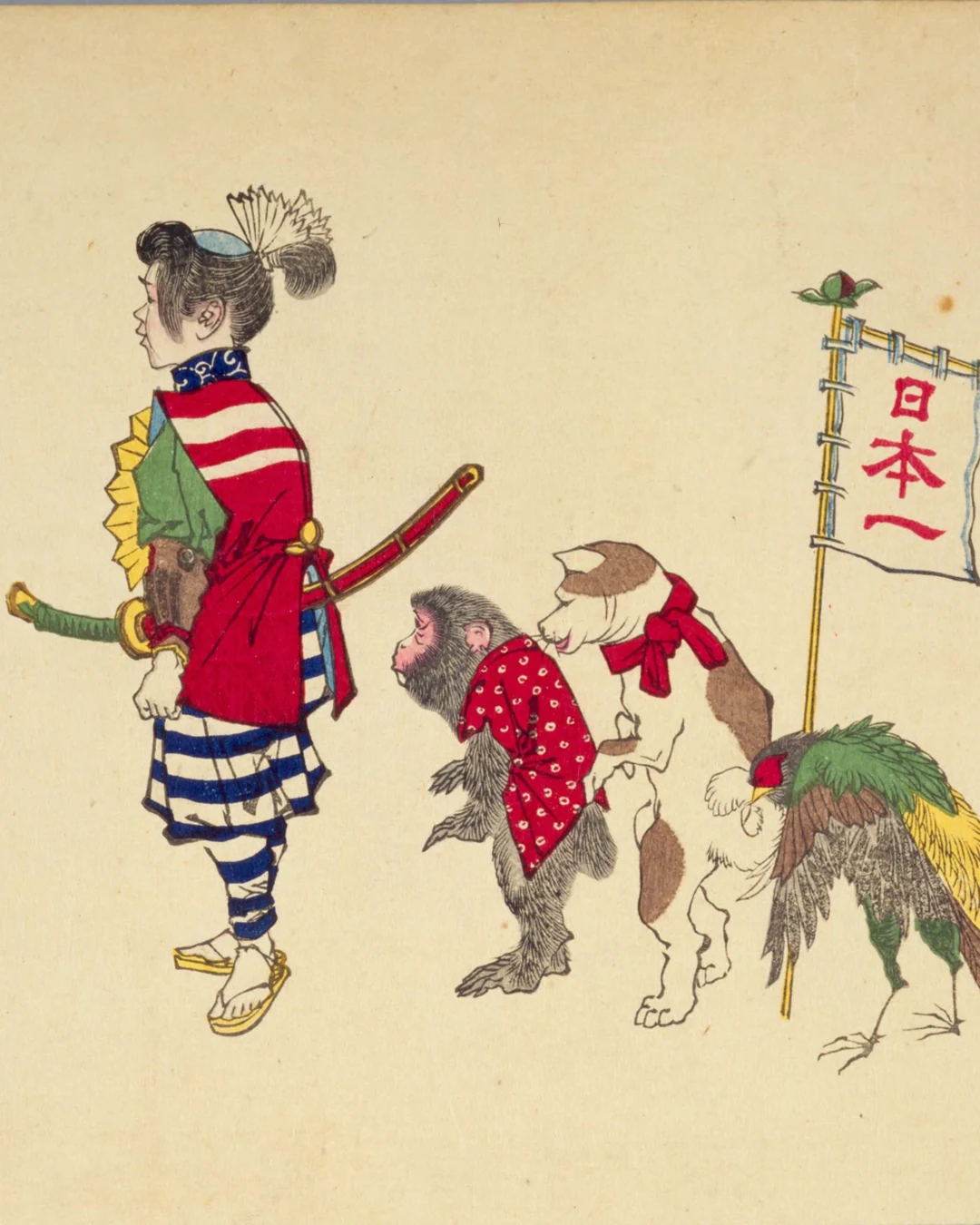
A Momotaro tattoo means courage, loyalty, and the strange fact that the right companions show up when you set out to do something hard. Momotaro is the Peach Boy who sailed to Demon Island with a dog, a monkey, and a pheasant. It is the first story most Japanese kids learn, and most pages leave it there, a bedtime tale. On skin it is a demon hunt with a child at the front of it, and that makes a better tattoo than its reputation suggests.
What Momotaro Means in a Tattoo
Setting out
An old woman washing clothes in the river sees a huge peach floating by and carries it home. When the old man cuts it open there is a boy inside, and they raise him as their own and call him Momotaro, peach boy. He grows up fast and strong, the way these boys do, and one day he tells the old couple he is going to Onigashima, the island of the oni, to put a stop to the demons raiding the coast. The boy is not sent; he chooses. For a client at the start of something, a career, a family, a recovery, that is the beat they are after, and a small figure on the road carries it without a speech.
The companions
The old woman packs him kibi dango, millet dumplings, and the dumplings are the engine of the story. On the road a dog asks for one and joins him. Then a monkey. Then a pheasant. None of them are heroes. A dog, a monkey, and a bird.
There is an old reason it is those three and not a bear and a hawk. The direction demons come from, the demon gate, sits at the northeast, ox and tiger on the old compass, which is why an oni wears ox horns and a tiger-skin loincloth. Across the compass from it sit the monkey, the bird, and the dog. Momotaro goes after the oni with the three animals that stand opposite them.
They are the part people remember, and they are the part I like to draw. They are loyalty that was earned with a dumpling and then never questioned. A Momotaro piece that leaves them out misses the story. A piece that gives each one its own character, the dog eager, the monkey sly, the pheasant proud, is a piece with three extra subjects for free.
The oni
Momotaro and the three take the island, beat the oni, and carry the stolen treasure home to the village under a banner that reads Nihon-ichi, number one in Japan. Japanese tattooing loves an oni, and a Momotaro composition gives you a reason to put them in a piece as the thing being overcome rather than the thing being worn.
The tradition also keeps a second reading, and it is old enough to count. A century ago Akutagawa retold the story from the island: the oni were living quietly on Onigashima until a boy turned up for their treasure. Most people wear Momotaro as the hero, and the story holds that. A few wear him knowing the oni had a side too, and that is a reason to give the demons some dignity along with the teeth.
The peach
A peach is not a soft thing for a demon hunter to be born from. In the oldest Japanese chronicle, Izanagi flees the underworld with a horde of demons behind him, throws three peaches at them at the pass, and they turn back. The peach has been a thing that drives demons off ever since, and a boy who comes out of one is built for the job. On its own the peach still means long life and keeping evil away, and on a bigger project the peach floating down the river is the opening scene.
Momotaro Pairings and Backgrounds
Water and the river
The peach comes down a river and the companions cross the sea, so water is the natural background. Waves and finger waves work for the crossing; a calmer river works for the peach.
Clouds and the island
Onigashima is a rock in the sea, and on a large piece it sits at one end of the composition with the oni on it, under clouds, while the boat comes in from the other. That layout is close to how the samurai and demon scenes are built, and it fills a back the same way.
Peach blossoms
Peach blossoms are the seasonal note. They are not cherry blossoms: peach petals are a deeper pink and come to a point. In a Momotaro piece they tie the boy back to the fruit he came from.
How Momotaro Fits the Body
Sleeve
The road scene, Momotaro walking with the three companions in a line behind him, is a natural sleeve. The figures wrap the arm one after another, the banner runs up the shoulder, and the water or the road fills in below.
Backpiece
The full story, the boat, the island, the oni, and the fight, is a backpiece. It is a busy composition and it needs a back to breathe.
Single pieces
The peach with leaves, a single companion, or Momotaro cutting his way out of the peach each works as a smaller piece on a calf, a forearm, or ribs, and each one can be built toward the larger story later if the client wants to keep going.
Momotaro in Japanese Prints

The print artists drew Momotaro at every stage. Yoshitoshi sketched him on the road with the three companions behind him and the banner up, which is the image at the top of this post, and in the triptych here he has him scattering beans at a crowd of oni, the same Setsubun bean-throwing that chases demons out of Japanese homes every February. The boy is drawn as a boy, small against the demons.
What Makes a Momotaro Tattoo Hold Up
A boy drawn as a boy
Momotaro is a child with a sword bigger than he is. Draw him small and confident. A grown man in the same outfit reads as a costume.
Three animals with three characters
If the dog, the monkey, and the pheasant come out as a row of pets, the piece is flat.
Oni that are worth beating
The demons should be big, ugly, and dangerous. The story only works if the odds look bad.
Planning a Momotaro Tattoo With Dave
Momotaro is a scene subject with a lot of pieces, so at the consultation we decide how much of the story you want on you: the road, the crossing, the fight, or just the peach. That decides the placement, and you will know the session count and cost per session before we start.
The road scene fits a sleeve; the whole story wants a backpiece. Send a tattoo request with the part of the story you keep coming back to. The meanings index covers the rest of the motifs.
I tattoo in Havelock and see clients from New Bern, Jacksonville, and across Eastern NC.
Frequently asked questions
What does a Momotaro tattoo mean?
Courage, loyalty, and setting out on your own decision. The Peach Boy chose to go after the oni; the dog, monkey, and pheasant who followed him are the loyalty half of the meaning, and the demons he beat are the thing overcome.
Is Momotaro a common Japanese tattoo subject?
Less common than the dragon, koi, or tiger, and more common than people expect. The story has been drawn by Japanese print artists for two centuries and it gives a tattoo a hero, three animals, demons, water, and a peach in one composition, which is a lot of material for a sleeve or a back.
Where does a Momotaro tattoo go?
The road scene, the boy with his three companions in a line, fits a sleeve. The whole story with the crossing and the fight wants a back, and the peach on its own works small on a calf, forearm, or ribs.
More subjects in the Japanese tattoo meanings index.
If this was useful, you can make davetedder.com a preferred source on Google. Your own search results will show this site more often.
Make davetedder.com a preferred source