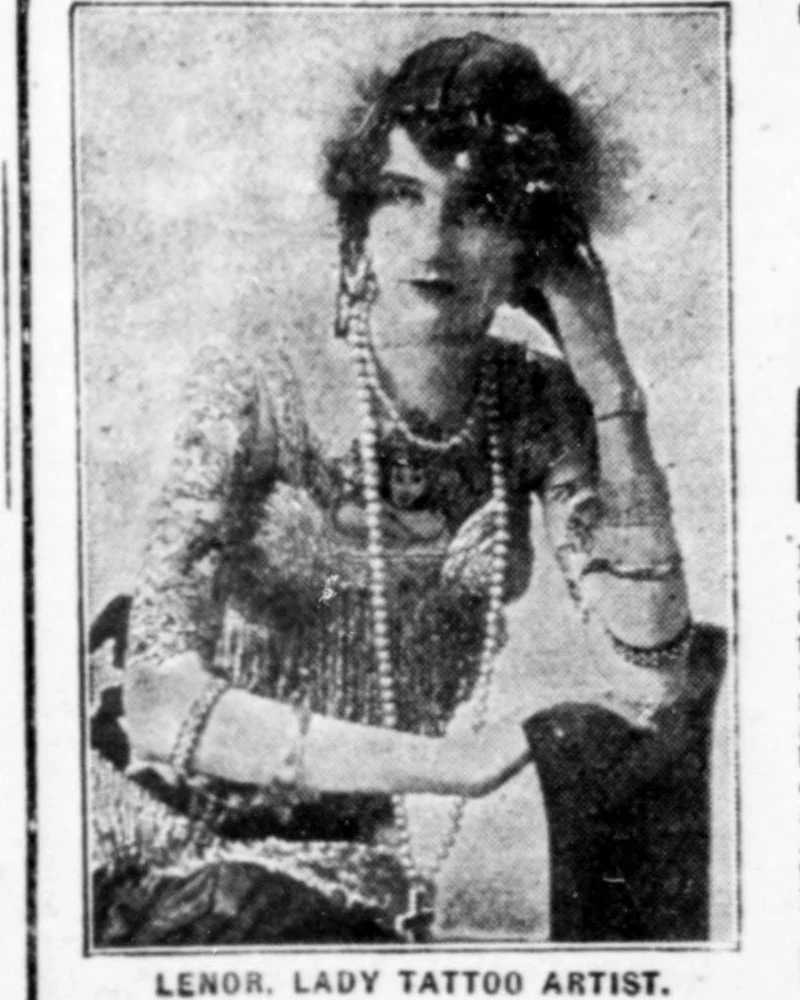
Cap Coleman is the name people use when they talk about the Norfolk tattoo era. Lenora Platt is the name people miss.
She was one of the first professional women tattooists in the United States, and in 1919 she had enough work on Norfolk’s East Main Street to advertise nationally for two more lady tattooers. She came to Hampton Roads during the First World War, tattooed soldiers in Newport News, then crossed the water to open her own studio on East Main in the first days of 1919, a year after Cap Coleman got to town. She’s buried at Forest Lawn Cemetery in Norfolk, alongside her fifth husband Dorse Blair, under a marker that reads simply “Lady Lenora.” The stone was placed by November 2019 through an effort led by Norfolk tattooist Brandon Glass, working alongside Platt’s family and building on documentary work by tattoo historian Carmen Forquer Nyssen. This piece is about her.
1. The biographical record

Lenora Platt was born in Pittsburgh, Pennsylvania, in 1883 (her grave record names her Mary Matilda Platt Blair; Blair was her last married name).1 She entered the tattoo trade in the years just before 1914 (her 1919 ads say she’d been known for five years as a lady tattoo artist), learning the craft while traveling with carnivals and working in dime museums. The dime museum circuit of the early twentieth century was a difficult and often exploitative working environment, particularly for women, with persistent rumors of women being pressured into receiving tattoos for display purposes. Working in those conditions cost Platt her health (she lived with chronic illness through the rest of her career), but it gave her the technical training and the trade-network access that working tattooists of the period built their reputations on.

She married five times across her working life. None of her husbands were involved in the tattoo industry, and none of the marriages endured, by her own and contemporary accounts because of the demanding hours and the transient working life the trade required of her. The biographical fact matters less for its own sake than for what it tells us about the period. A woman in 1910s and 1920s American working life was expected to be either supported by a husband or limited to the few trades open to single women. Platt was neither. She was a fully working independent professional, and she stayed that way.
Her arrival in Hampton Roads came during the First World War. She came with the Sheesley Traveling Carnival, which was passing through the region as the wartime military buildup expanded the Newport News shipyard and brought thousands of servicemen and shipyard workers into the area. It’s the same outfit that brought Coleman to Norfolk in 1917. Platt saw the commercial opportunity and acted on it. She opened a tattoo studio on Washington Avenue in Newport News, near the shipyard, and began taking the wartime trade directly.
2. The Newport News shop and the move to Norfolk

Platt’s Newport News studio operated in a market that was hungry and underserved. Wartime Hampton Roads was a Navy-shipyard region with a massive temporary population of military and civilian workers, almost all of them men, almost all of them with shore-leave money and shore-leave time. She built a reputation that drew servicemen in across the region.
Her female identity was a working asset rather than a working obstacle in this market. The novelty of a professional female tattooist drew curiosity-seekers; the underlying quality of her work converted the curiosity into repeat business and word-of-mouth referral. Platt understood the dynamic and used it. In January 1918 Billboard reported that she had “made a nice little B. R. at Newport News tattooing the soldier boys,” a bankroll, in carnival talk.

At the end of 1918 she was laid up for ten weeks with the flu in Pittsburgh. In January 1919 she wrote to Billboard that she was leaving for Norfolk to open a tattoo studio, and she did. By August she was opening a store at 1020 East Main with a soft drink counter up front, and by her own count it was the first summer in five years she hadn’t gone out with the shows. The city directory has her at 1015 East Main in 1923 and again in 1928. In between the same shop is listed under Mrs. Lenora P. Sharkey (1924, and at 511 1/2 East Main in 1925), which looks like one of her marriages. The competitive dynamic this set up is the one that earns her the most documentary attention in the published record.
In March 1919 she ran an ad in Billboard headed “Tattoo Artist Wanted.” She was “Now located on the main street in the direct heart of the business section of one of the best port cities,” with an “opening in her studio for at least two lady tattoo artists who can do first-class work. Enough business now to keep three tattooers busy.” She guaranteed $100 a week to anyone quick and good. The ad doesn’t tell us whether she found them. It does tell us the work was there, and that she meant to fill the shop with women.
According to the Historic Headstones of Norfolk profile, her male competitors began running their own ads for women tattooers.1 I haven’t found those ads yet. What the paper does show is a woman running her own shop on East Main from 1919 and advertising nationally for help. That’s a long way from the standard telling of the Coleman era, in which Coleman is the towering male figure of the East Main Street tattoo trade and the women of the shop are background or unnamed.
3. Women in the early American tattoo trade, with Norfolk as a case study

The early twentieth-century American tattoo trade wasn’t a male-only trade. It was a male-dominated trade in which a small number of professional women established themselves through a combination of carnival training, technical skill, and the kind of market positioning Platt practiced. The dime museum and carnival circuit was the most common training environment for female tattooists of the period, in part because more formal apprenticeship paths in shop settings were rarely open to women, and in part because the carnival and dime museum economies were already comfortable with female performers and female workers in ways the average city tattoo shop was not.
Platt is one of the best-documented examples of how that path could lead to a successful working career. She converted carnival training into shipyard-market commercial success in Newport News, then into competitive commercial success in Norfolk, then into a Norfolk shop busy enough to advertise nationally for two more tattooers. It demonstrates that a working female-led tattoo shop was commercially viable in 1920s Norfolk in a way that the standard history of the East Main Street era usually misses.
If the men on the strip did start recruiting women of their own, that says her shop was winning enough of the market to force a response. Either way, her own ad says the work was there: by 1919 a woman on East Main had enough business to keep three tattooers busy.
It’s worth noting one historical continuity that bookends the Norfolk story. When Norfolk finally repealed its 1950 tattoo ban in 2006, the first licensed professional studio to open inside city limits under the new ordinance was a shop founded in 2007 by a female artist, called All Out Tattoo. The continuity isn’t a direct lineage in any biographical sense (the modern shop owner and Platt are separated by more than four decades during which Norfolk was a closed city for tattoo work), but the symmetry of the bookends is striking. The woman who broke the East Main Street market open in 1919 is bookended by the woman who reopened the Norfolk city license market in 2007. The intervening 88 years are the long arc of the city’s relationship with the trade.
4. The Forest Lawn grave and the preservation movement
Platt was still tattooing at 1015 East Main in 1928 and had stepped away by 1930 as the chronic illness she had carried since her carnival years caught up with her. She lived another two decades in semi-retirement and passed away on October 28, 1960. She’s buried at Forest Lawn Cemetery in Norfolk, the same cemetery where Cap Coleman and E.J. Miller are also buried. Her plot is at Forest Lawn, Northeast Center II section, Block T, Space 4, next to her fifth and final husband Dorse Blair in Space 5.2
The grave was unmarked for nearly six decades. By the time the Historic Headstones of Norfolk blog ran its March 2019 profile of Platt, Norfolk tattooist Brandon Glass had already been quietly working the question of a proper stone for several years, with documentary support from tattoo historian Carmen Forquer Nyssen (who had established Platt’s Find a Grave memorial in July 2015) and from family members reached through the Platt and Blair lines. By November 2019 the work was done. The marker now in place reads simply “Lady Lenora,” the working name she used through her career.2
The stone also corrects one of the standing assumptions in the cemeteryguy 2019 telling. That post described Platt as having had no family in the Norfolk area at the time of her death. The Find a Grave record shows otherwise, with step-grandson and great-niece contributors active on the memorial through 2024 and 2025, and Platt’s fifth husband Dorse Blair buried in the next plot.2 The full circumstances of how Platt came to be buried unmarked for nearly sixty years are more complicated than “nobody was here,” and the corrected version of that story belongs to Glass, the family, and the tattooists who closed it alongside him, not to this page. For the lineage record: Platt’s grave is at Forest Lawn, marked, alongside Dorse Blair’s.
A self-guided walking tour of the Forest Lawn graves and the East Main Street block is planned for publication on this site, with primary-source photography from the cemetery and the surviving block. That piece will include Platt’s plot specifically; this profile will link to it once the tour is published.
For anyone wanting the full corrected Norfolk story, the editorial corpus this piece sits inside is at Norfolk Tattoo History. The pre-Coleman cohort, the Coleman and Barrs era, the 1950 ban and the Portsmouth exile, the 1999 to 2002 Ancient Art court case that helped reopen the regional trade, and the 2006 Norfolk re-legalization that brought the city license market back, all of it is there. Lenora Platt’s chapter is one of the load-bearing pieces of the longer arc.
Notes
1 “Lenora Platt: Norfolk’s Tattoo Pioneer,” Historic Headstones of Norfolk (March 19, 2019). Primary source for the biographical record, the Newport News shop, the East Main Street Norfolk shop, the 1919 Billboard advertisement, the marriages, the chronic illness, and the 1960 death. historicheadstonesofnorfolk.wordpress.com
2 Find a Grave Memorial ID 149396972, Mary Matilda “Lady Lenora” Platt Blair, established July 17, 2015 by tattoo historian Carmen Forquer Nyssen. Source for the corrected plot location (Northeast Center II, Block T, Space 4, with Dorse Blair in Space 5), the November 2019 marker placement (memorial-stone photograph contributed by step-grandson Nick Sloan), the “Lady Lenora” inscription, and the documented family contributors. findagrave.com
Additional supporting references and the broader pre-Coleman, Coleman-era, and post-ban context for this profile are documented in the editorial corpus at /norfolk-tattoo-history/.
If this was useful, you can make davetedder.com a preferred source on Google. Your own search results will show this site more often.
Make davetedder.com a preferred source