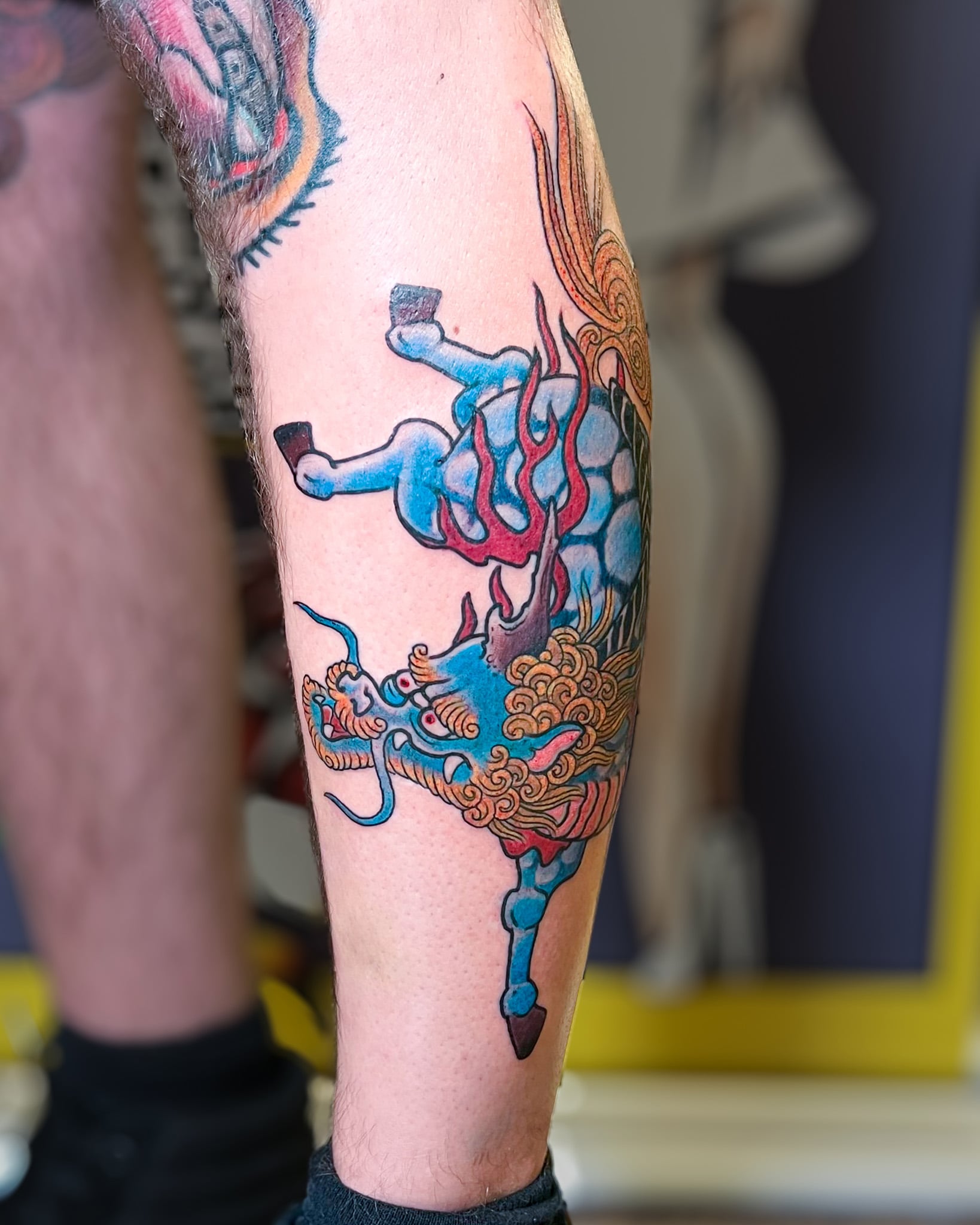
A kirin tattoo means good fortune and a good omen, and specifically the kind that arrives on its own. In Chinese and Japanese legend the kirin appears when a wise ruler takes the throne or a sage is born, and it is so gentle it will not step on living grass or eat living flesh. It looks like it could tear you apart. It never does.
That contradiction is why I like the subject. You will see the kirin called the Japanese unicorn, which gets the horn right and everything else wrong. It is not a horse, it does not protect anyone, and it does not bring the luck. It shows up because the luck is already on its way. Most people know the beast from the beer label and nothing else, and a properly drawn kirin surprises them.
What a Kirin Represents
A sign that things are about to go right
The old story has a kirin walking into the house before Confucius was born, and the sign was read the way it was meant: a sage is coming. Near the end of his life a hunting party dragged in a strange animal they had run down and killed, and he was the one who named it. A kirin, come at the wrong time, to the wrong people, and dead for it. He put down his brush on the history he was writing and did not pick it up again. That is the whole animal in one story. When it shows up whole, things are in order. When it is harmed, they are not.
In Japan it kept that meaning: the kirin is the beast of a peaceful reign, and a kirin tattoo is, at bottom, a wish for a good stretch of life. That birth story is why, across China and wherever the beast travelled, a kirin is also a wish for a child, and a gifted one. A kirin for a new parent, or for the child, is a reading the tradition backs.
Power that chooses not to be used
The kirin has a horn and hooves that could crush, and it walks so lightly it bends nothing. It is the animal version of restraint. The older Chinese tellings give it a temper for the wicked, which is the point: the gentleness is a choice made by something that could do otherwise. Where the tiger is force willing to be used, the kirin is force that has decided not to be. That is a rarer thing to want on your skin and, in my experience, a more interesting client.
What it says about you
In tattooing the kirin is a less common subject than the dragon or the tiger, and that is part of its value. Anyone who knows the tradition reads it as a sign that you looked past the first page.
What a Kirin Looks Like

The kirin is built out of other animals, and the parts are what tell it from a dragon. The body is a deer’s, scaled like a fish or a dragon, on a deer’s legs with hooves, never claws. The head is close to a dragon’s, with a single horn or a pair of antlers, and a mane and a beard. The tail is an ox’s. Flames come off the shoulders and the legs, and the whole animal is usually drawn in motion.
The Japanese encyclopedia illustration here is about as plain a description of that list as you will find. Every kirin I draw starts from it.
Kirin, dragon, shishi, baku
Clients mix these up, so here is the short version. A dragon has claws, a snake body, and no hooves. A shishi is the lion-dog with the curly mane and the round face, the temple guardian. A baku is the dream-eater with an elephant’s trunk. A kirin is the one on hooves.
Kirin Pairings and Backgrounds
Clouds and flames
A kirin travels on clouds and carries its own fire, so the background is half decided before you start. Clouds give it something to move across, and the flames off the shoulders tie the animal into the background the way wind ties a tiger into bamboo. The background post covers how that holds a piece together.
Peonies and chrysanthemums
Flowers suit the kirin better than they suit most beasts. Peonies give it richness and chrysanthemums give it a seasonal setting. A kirin with peonies reads as prosperity twice over.
As a mount

The scroll here is a Kano school painting of the Queen Mother of the West riding a kirin. Painters put deities on its back, and that is a pairing that still works: a figure seated on a kirin says the rider is someone the beast would carry.
Not with a fight
The one thing I steer people away from is a kirin in combat. A kirin fighting a tiger or a dragon misreads the animal, and the old story says what a harmed kirin means. Put it in motion, not in battle.
How a Kirin Fits the Body
Calf and lower leg
The kirin at the top of this post is on a calf, and the lower leg suits it. A striding animal on hooves wants a vertical space with some length, and the calf gives you the muscle underneath to carry the movement.
Thigh and half sleeve
A kirin fits a thigh at full stride and an upper arm curled around the shoulder. On an arm the flames and clouds wrap around and give the piece a back side, which is where a single-subject sleeve often falls short.
As part of a larger project
Within a leg sleeve or a bodysuit the kirin is a good secondary subject, the beast that fills the calf while a dragon or a figure takes the thigh, and it brings its own clouds and fire with it. The old Chinese classics count it among the four auspicious beasts with the dragon, the phoenix and the tortoise, so a kirin next to a dragon is not a random pairing, it is a set.
What Makes a Kirin Tattoo Hold Up
Hooves and a deer’s legs
The legs are where a kirin goes wrong. Drawn like a dragon’s, with claws, it is a dragon with a deer’s body pasted on, and everyone who knows the animal will see it.
A face that is fierce but not angry
The kirin looks dangerous and is not, and the face should carry that. Open mouth, bared teeth, and eyes that are alert rather than enraged. It is a fine line and it is the whole character.
Flames with a direction
The shoulder flames should stream the same way the animal is moving. Flames pointing every direction turn a kirin into a decoration.
Planning a Kirin Tattoo With Dave
A kirin is a subject I get asked for a few times a year, and every one is a pleasure because the client usually knows something. At the consultation we settle the pose and the placement and what the flames and clouds are doing, and you will know the session count and cost per session before we start.
If the kirin is one piece of a leg sleeve, say so, and send a tattoo request with the placement you have in mind. The meanings index covers the rest of the motifs.
I tattoo in Havelock and see clients from New Bern, Morehead City, and across Eastern NC.
Frequently asked questions
What does a kirin tattoo mean?
A good omen. The kirin turns up when the world is in order and never when it is not, so the tattoo is a wish for a good stretch of life. The second meaning is restraint, an animal that could do damage and chooses not to.
What is the difference between a kirin and a dragon?
Hooves. A dragon has claws and a long snake body; a kirin stands on a deer’s legs, and once you have seen the hooves you cannot mistake the two, whatever the head and the flames are doing.
Is the kirin the same as the Chinese qilin?
Yes. Kirin is the Japanese reading of the Chinese qilin, and the animal came into Japanese art with the rest of Chinese learning. The Japanese versions tend to look more like a deer with dragon features, while older Chinese ones can look more like a lion or an ox, but it is the same beast with the same meaning.
More subjects in the Japanese tattoo meanings index.
If this was useful, you can make davetedder.com a preferred source on Google. Your own search results will show this site more often.
Make davetedder.com a preferred source