
A kappa tattoo means water, mischief, and a warning, and like a lot of Japanese art, it has a sense of humor. Most pages pick a side, the round green rascal with a cucumber or the river monster that drowns horses, and the folklore never did. The same creature that loses a fight by bowing will take a swimmer by the ankle. The wearer picks which side faces out.
What a Kappa Means in a Tattoo
Water and where you come from
Kappa means river child, and every river in Japan used to have one. Anyone who grew up near a river, a creek, or a coast has a kappa story of some kind, even if it is not called that. Around here it is the sound and the moccasin under the dock. The kappa is a way of putting water on your body with a character in it rather than just a wave.
A warning you keep
Farmers in Japan told their kids about the kappa to keep them off the riverbank, and the old stories are blunter than a tattoo needs to be. The kappa waits in the shallows, pulls horses and swimmers under, and does not let go. Nobody draws that part, but it is the reason the smile is not harmless. The kappa is the danger you were warned about as a kid, and the tattoo carries that warning along with the comedy. Some clients get one exactly for that: a reminder, with a grin on it, not to get too comfortable.
A monster with manners
The story that gets told most is the one where the kappa loses by being polite. Its strength lives in the dish of water on its head, the sara, and the dish has to stay full. A man meets one on the bank and bows. The kappa cannot help itself, it bows back, the dish tips, and the thing that could have pulled him under is crawling for the river with its strength running down its face. Politeness as a weapon, and politeness as the one weakness the monster cannot fix.
The other story is the one about the horse. A kappa in the shallows grabs a horse by the tail, the horse bolts, and the kappa is dragged into the yard with its arm torn off at the shoulder. That night it comes to the door to beg for the arm back, and the price it pays is the recipe for its bone-setting salve. Families of bonesetters in Japan claimed for generations that their ointment came from a kappa, which is how a river monster ends up in the history of Japanese medicine as well as its nightmares. That is the meaning the generic pages skip: a kappa keeps its word and pays its debts, even to the man who caught it. Someone who has been caught and made good on it has a figure here.
Mischief
The kappa is a trickster. It is rude, greedy, and easily fooled, and there is a kind of person who sees that and says, that’s me. Those are good tattoos to make.
Which Kappa: The Wrestler or the Rascal

Kuniyoshi drew the kappa as a real opponent. The print here is the warrior Takagi Toranosuke wrestling one underwater in the Tamura river, a man against a monster in the dark with the water swirling around them. It is one of the scenes I point clients toward when they want a kappa that is dangerous rather than cute, because it puts the creature in its element and gives it an enemy worth having.
The other tradition is the comic one, the round green rascal with a grin, and it is just as old. Both are inside the tradition, and the piece decides which one you get.
Kappa Pairings and Backgrounds
Water, always
A kappa lives in water and the tattoo should too. River water, waves, or a pool under a willow. The water is what tells you what the creature is, and the background post covers how to make it move.
Cucumbers and lotus
A cucumber in the hand is the classic prop, and the reason a cucumber roll is called kappa-maki. It is the kappa’s soft spot: offer it one and it is yours, and a kappa holding one is a smiling monster. Lotus and water plants set the river’s edge and give the piece some green that is not the kappa.
Koi and frogs
A kappa shares the water with the koi, and a kappa grabbing at a passing koi is a composition with some life in it. Frogs are the other river creature that pairs naturally, and the two together make a leg full of things that live in a pond.
A sumo match
The other thing a kappa cannot resist is a sumo match, and it will challenge anyone at the water’s edge and usually win. A kappa in a hold with a man, or with another kappa, gives you two figures and a real action, a scene rather than a spot piece.
How a Kappa Fits the Body
On its own
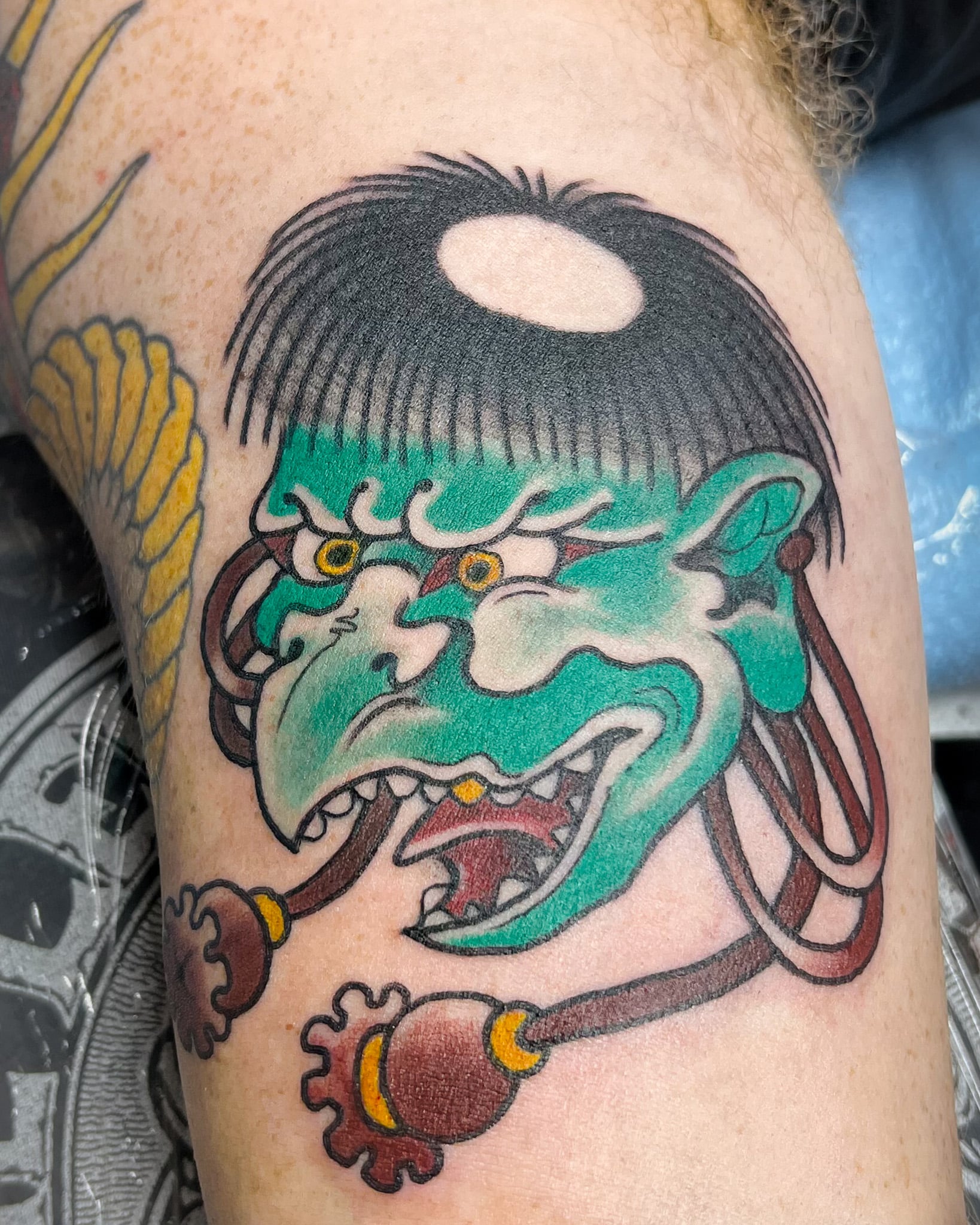
A kappa by itself is a small tattoo, and that single-figure size is what most people want. The one at the top of this post is the whole creature, on a thigh. The one pictured here is the mask, just the face, on the inner bicep of my buddy Brandon Glass, a fellow tattooer at Rocksteady Tattoo in Norfolk. The creature is small and round, and a calf or a forearm takes the full figure just as well.
In a leg sleeve
A kappa is a natural secondary subject for a leg sleeve built on water. Put the koi and the waterfall on the thigh and the kappa in the pool at the bottom, near the ankle, where a river creature belongs.
Ribs and thigh
The two-figure scene, kappa against man, wants a thigh or the ribs, because two figures need the length.
What Makes a Kappa Tattoo Hold Up
Three things make it a kappa and not a turtle-frog: the dish on the head with water in it, a beak where a mouth would be, and a shell where a back would be. Everything else, the webbed hands, the scales, the ring of hair around the dish, is character, and there is room to play there. The green is a solid mid-green with black shading; a saturated green field against black water is the contrast that keeps it readable as it ages.
Planning a Kappa Tattoo With Dave
A kappa is usually a quick decision and a fun one. At the consultation we settle which kappa you want, what it is holding, and how much water it gets, and you will know the session count and cost per session before we start.
A kappa on its own is a small piece, and as part of a water composition it belongs in a leg sleeve. Send a tattoo request with the placement. The meanings index covers the rest of the motifs.
I tattoo in Havelock and see clients from Morehead City, New Bern, and across Eastern NC.
Frequently asked questions
What does a kappa tattoo mean?
Water, mischief, and a warning. On the body a kappa is water with a character in it, the river or the creek you grew up near with something living under the surface, and it keeps the warning you got as a kid about the bank without taking itself too seriously. The dish of water on its head, where its strength lives, is the one detail it cannot be drawn without.
Is a kappa tattoo supposed to be funny?
It can be, and it does not have to be. The round kappa with a cucumber and a grin is as old in the prints as the one wrestling a warrior underwater, and the same folklore that has it drowning people has it losing a fight by bowing. Pick the side that is yours; the tradition has room for both.
Where does a kappa tattoo go?
Low, and near water. By itself it does not need much room; the two on this page sit on a thigh and an inner bicep. In a leg sleeve built on water it sits in the pool at the bottom, near the ankle, under the koi and the waterfall, and the wrestling scene needs the length of a thigh or the ribs.
More subjects in the Japanese tattoo meanings index.
If this was useful, you can make davetedder.com a preferred source on Google. Your own search results will show this site more often.
Make davetedder.com a preferred source