Japanese Sleeve Tattoos by Dave Tedder
A Japanese sleeve tattoo with me is drawn to your arm, built in three full-day sessions, and priced as a range you can read before you ever send a message. I have been tattooing since 2000, large-scale Japanese work is what I do, and the sleeve is the project I build more than any other. The finished ones are in the large-scale portfolio.
Work featured in International Tattoo Art, Skin & Ink, Tattoo Savage, Prick and ten more tattoo magazines, 2004 to 2014.
Rather talk it through first? Call or text me at 331-588-4848.
Dave has given me a full arm, leg, and back piece and has done a phenomenal job. Super professional but also just a really cool guy.
★★★★★ Wesley T., Google review
What a Japanese Sleeve Covers
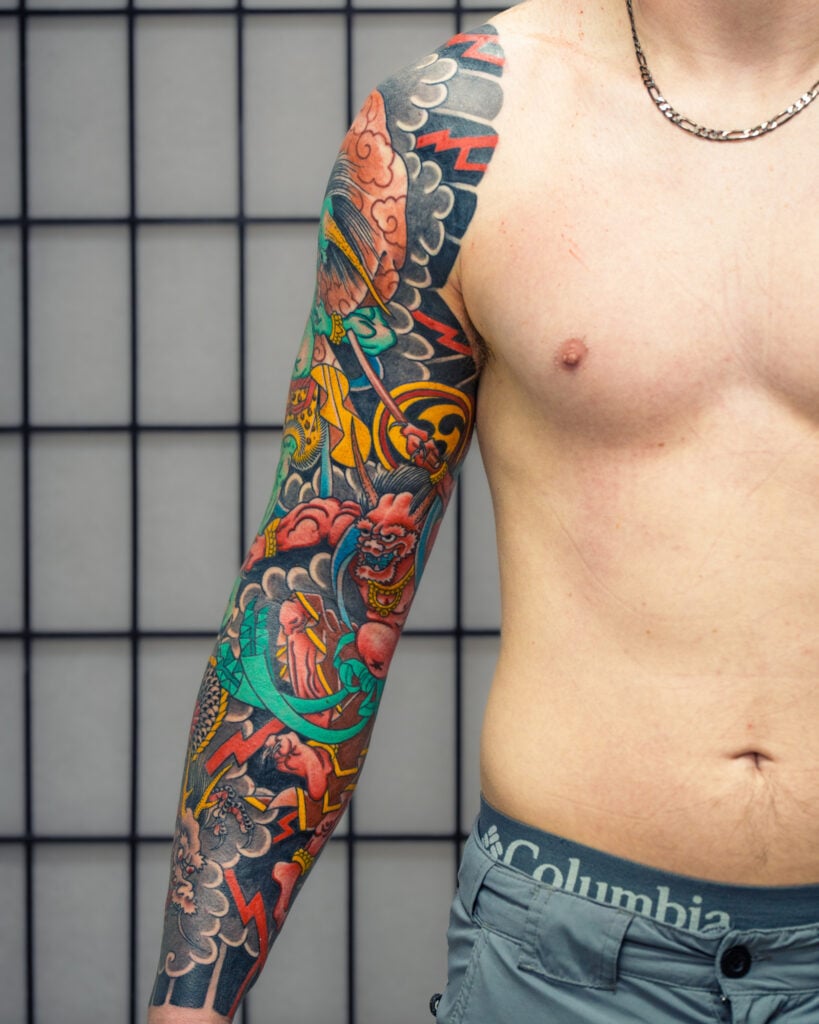
A full sleeve runs from high on the shoulder to the wrist bone. In the traditional vocabulary that is a nagasode, a long sleeve, and it is the standard unit of large Japanese work on the arm. A half sleeve covers shoulder to elbow or elbow to wrist and is a good first project for someone new to this scale of tattooing.
The sleeve can also carry onto the chest. That chest panel is the hikae, and it turns an arm project into a sleeve-and-chest composition with the subject reading across the shoulder instead of stopping at it. It adds a session or two and it is the most common way a sleeve grows into something larger. If a bodysuit is ever in your future, the sleeve and hikae are usually where it starts.
The trade terms matter for scope and pricing, not for conversation. Use whatever words you have. The glossary explains the structure vocabulary if you want it.
How a Sleeve Is Built

Every large Japanese piece I do follows the same order: outline, then background, then foreground. The outline session places every element on the arm in relation to every other one, so the composition is settled before any shading exists. The background session lays in the wind, water, clouds or rocks that hold the subjects together and make the arm read as one piece instead of a collection of tattoos. The foreground session brings the main subjects up in color and detail.
The design is drawn to your arm specifically, around the shape of the muscle and the way the arm turns, so the piece reads from every angle rather than from one flat view. That is the difference between a sleeve that flows and one that fights the body. The full session-by-session timeline is written up separately, and why the background holds the tattoo together explains the part of this most people underestimate.
What a Japanese Sleeve Costs
A full arm sleeve at my studio in Havelock, North Carolina runs $3,000 to $4,500 per arm over three sessions. A sleeve with the chest panel runs 4 to 5 sessions per side at $3,500 to $5,200. A $300 deposit holds the project and starts the drawing, and you pay per session as the work progresses. These are ranges rather than a single number because the final figure depends on the design, the placement and any existing work we build around, and I give you a straight estimate of session count and total at the consultation. The whole price guide is public.
Lauren, Dave, and the rest of the staff are top notch. If you’re looking for quality work at amazing prices, this is the place! You won’t find a more inviting atmosphere, or a cleaner shop anywhere in town.
★★★★★ Braxton B., Google review
Subjects That Work on an Arm

An arm suits one main subject with a background that moves along its length. Dragons wrap the arm naturally and are the most requested. Koi climb it. Snakes coil through it. Tigers and the gods of wind and thunder, Fujin and Raijin, sit well across the upper arm and shoulder. A hannya mask reads strongly on the outer arm or the chest panel. I have written about most of these: dragons, koi, tigers, hannya masks and cherry blossoms, and the meanings index covers the rest.
What I will steer you away from is a sleeve made of several unrelated subjects. It is the most common thing people arrive wanting and the least likely to hold up over decades. One subject, one background, and the arm reads as a single piece from across a room.
Where the Work Happens and How to Start
I work at The Custom Tattoo Company in Havelock, North Carolina, and I hold regular residency dates at Electro Magnetic Tattoo in Chesapeake, Virginia for Hampton Roads clients. Current dates are on the travel page. Japanese work gets priority booking.
Send a tattoo request with the subject you are drawn to, where it goes and how much of the arm you want to cover. I follow up to talk it through, and the consultation is in person at the shop for local clients or by phone or video for anyone traveling in. What a consultation looks like is written up if you want to know what to expect.
- One drawing made for you, so the whole piece reads as one composition, not a set of separate tattoos.
- A session plan set before we start, built around your schedule.
- Your per-session price and a realistic session count before the first appointment.
I’ve never felt more comfortable sitting with a tattoo artist. They take the time to listen, make sure you’re totally at ease, and deliver phenomenal results every single time.
★★★★★ Tiana W., Google review
Rather talk it through first? Call or text me at 331-588-4848.
Common Questions
How many sessions does a Japanese sleeve take?
A full arm sleeve usually takes 3 full-day sessions spread over 2 to 4 months. The first is the outline, the second is background, the third is foreground. A sleeve that carries onto the chest panel runs 4 to 5 sessions per side.
How much does a Japanese sleeve tattoo cost?
A full arm sleeve runs $3,000 to $4,500 per arm at my studio in Havelock, North Carolina. With the chest panel it runs $3,500 to $5,200 per side. A $300 deposit holds the project and you pay per session as the work is done. The full price guide is public.
Can I start with a half sleeve and extend it later?
Yes, and I plan for it when that is the intent. A half sleeve is usually 2 sessions over 6 to 10 weeks. If you might extend to a full sleeve later, I design the half sleeve so the composition flows when we add to it, rather than having to work around a stopping point.
Do I need to know exactly what I want before I send a request?
No. Most people come in with a subject they are drawn to and a rough idea of coverage. The consultation is where it turns into a design. Japanese tattooing has real rules about which subjects pair with which backgrounds, and guiding your idea into a composition that sits well on your arm is part of the job.
Other large-scale projects: Japanese leg sleeve, Japanese backpiece and Japanese bodysuit. All four are described on the Japanese tattoos page, and the finished work is in the large-scale portfolio.