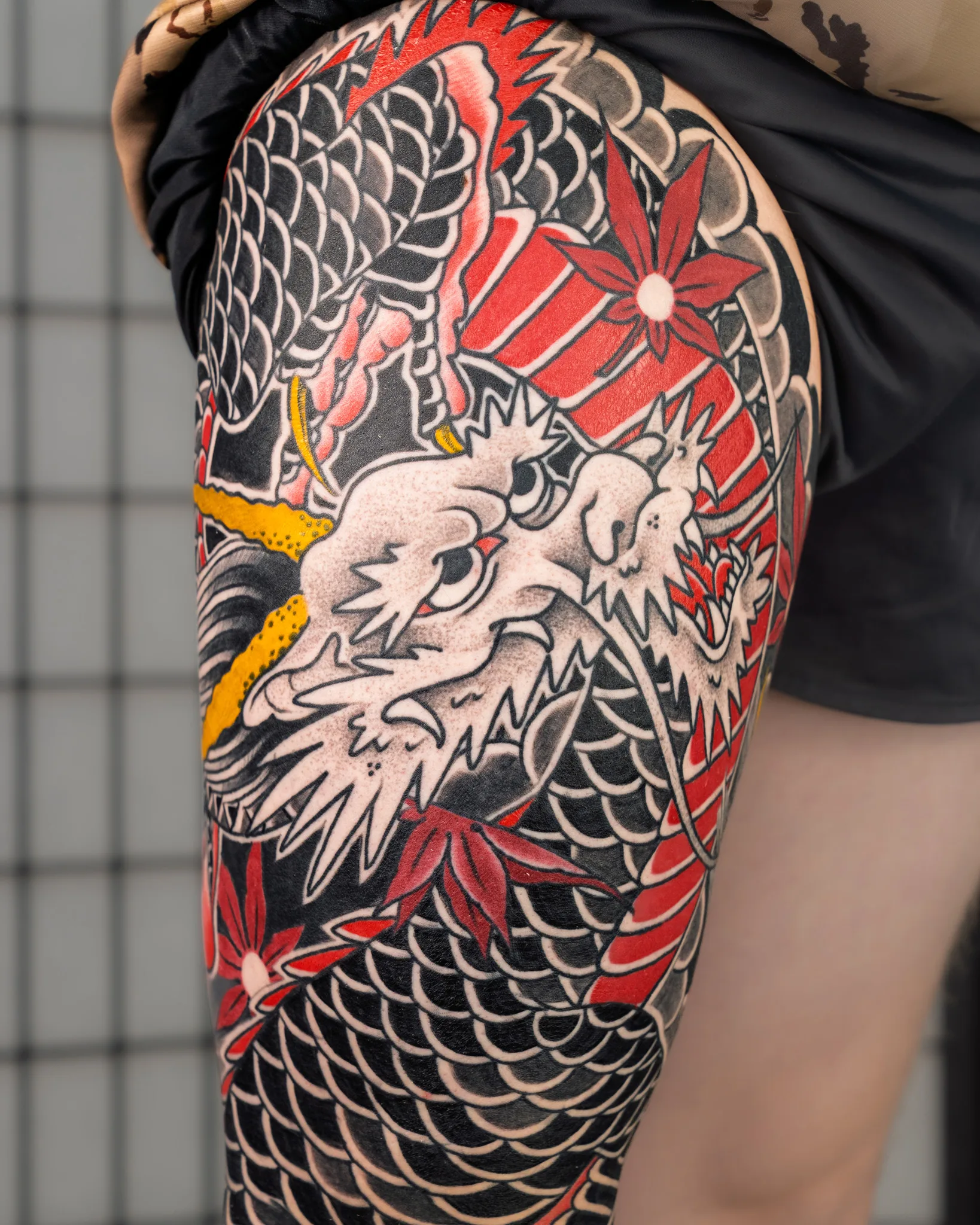
Japanese tattoo meanings come from folklore, religion and the old war stories: the dragon for protection and wisdom, the koi for perseverance, Fudo Myoo for the strength to hold your ground. Every subject below carries one, and most carry two at once.
I’ve been tattooing since 2000 and drawing Japanese work from the Edo-period woodblock print tradition, now at The Custom Tattoo Company in Havelock, NC. Find a subject for what it means and how it is worn, shown on my own work and on the prints the tradition comes from. Search by name in English or Japanese, or narrow the list to one group.
Creatures
Dragon
龍 Ryu
Water, wisdom and protection. The dragon brings rain and guards whatever it wraps around.
Read more about Dragon
In Japan the dragon is a guardian, not a monster to slay. It rules water and sky, and on skin it stands for wisdom and protection. It needs room, so it usually runs a full sleeve, a back or a leg.
Tiger
虎 Tora
Strength and courage, tied to the wind. Paired with bamboo, and set opposite the dragon.
Read more about Tiger
The tiger is strength, courage and protection, and its element is wind. It is the earthbound partner to the dragon, so the two are often set opposite each other as a balance, not a fight, and bamboo is its classic setting.
Koi
鯉 Koi
Perseverance. The carp fighting upstream, and the way it swims changes what it says.
Read more about Koi
The koi stands for perseverance, after the legend of the carp that climbs the waterfall and becomes a dragon. Which way it swims matters: fighting upstream reads as struggle still under way, swimming down as a fight already won.

Snake
蛇 Hebi
Change, renewal and protection. A creature that sheds its skin and keeps bad luck off.
Read more about Snake
The snake stands for change and renewal because it sheds its skin, and in Japan it belongs to Benzaiten, goddess of water and wealth, so it also carries good fortune and protection. Folklore gives it a darker side too: in the Dojoji story a jealous woman becomes a serpent. It is often worn with peonies, a Hannya, or fighting a tiger.

Dragon koi
鯉の滝登り Koi no takinobori
The carp that clears the falls and becomes a dragon: effort that changes what you are.
Read more about Dragon koi
A koi with a dragon's head, or a carp halfway to becoming a dragon, shows the end of the Dragon Gate story, where the fish that makes it over the falls turns into a dragon. It sits between the koi and the dragon in meaning, and suits someone who wants both.

Crane
鶴 Tsuru
Long life and loyalty. Folk saying gives the crane a thousand years.
Read more about Crane
Cranes stand for long life, good fortune and fidelity, and the old saying gives them a thousand years. In a tattoo the crane usually flies with pine, cherry blossom or lotus, and its long neck and open wings let the design follow the arm.

Baku
獏 Baku
The dream eater. It devours nightmares and keeps bad dreams away.
Read more about Baku
The baku is a beast of Chinese origin, pieced together from parts of other animals: legend says it was made from the spare pieces left over after the rest were created. In Japan it eats nightmares, and people once kept its picture by the pillow to sleep well. Worn as a tattoo it is a guard against bad dreams and bad luck.

Phoenix
鳳凰 Ho-o
A bird of good omen that appears in times of peace, the dragon's partner among birds.
Read more about Phoenix
The ho-o is the East Asian phoenix, a bird of good omen said to appear only in peaceful, well-governed times, and the leader of birds as the kirin is of beasts. It does not burn and rise again like the Western phoenix; its meaning is fortune, grace and right order. Its own tree is the paulownia, though tattooing often gives it peonies.

Turtle
蓑亀 Minogame
Long life. The old saying gives the turtle ten thousand years.
Read more about Turtle
The minogame is an ancient turtle trailing a long cloak of water weed from its shell, the mark of great age. The saying "the crane a thousand years, the turtle ten thousand" makes it the crane's long-life partner, and the two often appear together. A turtle also carries the fisherman Urashima Taro to the Dragon Palace under the sea.

Frog
蛙 Kaeru
Safe return and good luck. The word for frog also means "to return".
Read more about Frog
The frog is a luck charm built on a pun: kaeru means both frog and to return, so it stands for a safe trip home, money coming back and good fortune returning. Frogs also turn up as comic figures that wrestle sumo and act like people, and the giant toad belongs to Jiraiya, the toad-magic hero of the Edo stories.

Hawk
鷹 Taka
Strength, sharp sight and luck. A hawk is a lucky first dream of the year.
Read more about Hawk
The hawk was the bird of the samurai, who hunted with them, so it carries strength, focus and nobility. It is also lucky: Mount Fuji, a hawk and an eggplant are the best things to see in the first dream of the New Year. Japanese art usually perches it on a pine or shows it diving on prey.

Rooster
鶏 Niwatori
The bird that calls up the sun: courage, watchfulness and a new day.
Read more about Rooster
In the oldest Japanese myth the gods set the long-crowing birds to calling to bring the sun goddess Amaterasu back out of her cave, so the rooster belongs to the sun and the morning, and roosters are still kept at Shinto shrines. In Japanese art it is drawn proud and bright-tailed, and it stands for courage, alertness and a fresh start.

Heron
鷺 Sagi
Grace and patience: the white bird standing still in the shallows.
Read more about Heron
The heron, and above all the white egret, is the bird of stillness in Japanese art, standing in the water until the moment to strike. It stands for grace, patience and purity, and it gave its name to Himeji, the White Heron Castle, and to Sagi Musume, the kabuki dance of the heron maiden. It is drawn with reeds, willow, water or cherry blossoms.

Foo dog
唐獅子 Karajishi
The guardian lion at the gate: protection and courage, drawn among peonies.
Read more about Foo dog
What English calls a foo dog is the Chinese guardian lion, karajishi in Japanese art and the same creature as the komainu pairs at shrine gates. It guards doorways, so it means protection and courage. In tattooing it is almost always set among peonies, after the story that dew on peony petals kills the worm that lives inside the lion.

Mandarin ducks
鴛鴦 Oshidori
A devoted couple. The pair is the old symbol of a faithful marriage.
Read more about Mandarin ducks
Oshidori are mandarin ducks, and in Japan and China a pair of them is the old symbol of a faithful, lasting marriage; "oshidori fufu" still means a devoted couple. They are drawn as a male and a female together, usually on water among reeds or flowers. The mandarin duck's only close relative is the North American wood duck.

Namazu
鯰 Namazu
The giant catfish under Japan whose thrashing causes earthquakes.
Read more about Namazu
The namazu is a giant catfish living under the islands of Japan that shakes the ground when it moves, held down by the god of Kashima with a great stone. After the 1855 Edo earthquake hundreds of namazu-e prints showed it punished, pinned or blamed. It stands for upheaval kept under control.
Kirin
麒麟 Kirin
A beast of good omen that harms nothing alive. Part dragon, part deer, all gentleness.
Read more about Kirin
The kirin is a beast of good fortune that is said to appear when a wise ruler or a sage arrives. It is so gentle it will not step on a blade of grass. Hooves on a deer's legs tell it apart from a dragon, which has claws.

Puffer fish
河豚 Fugu
Poison and luck in one fish: the risk worth taking.
Read more about Puffer fish
The fugu is the puffer fish, which blows itself up to scare off enemies and carries a poison that can kill. In Shimonoseki, the fugu capital, people call it fuku, the same sound as the word for luck, to turn the name away from misfortune. On skin it means luck and danger together, and a risk taken with open eyes.


Gods and Buddhist figures

Daruma
達磨 Daruma
Perseverance. Knock him over and he rights himself.
Read more about Daruma
Daruma is Bodhidharma, the monk said to have brought Zen to China, who in legend sat facing a wall in meditation until his arms and legs withered away. The round, weighted Daruma doll comes from him and always rights itself, so he means perseverance and a goal kept in sight. One eye is painted in when the goal is set.

Fujin and Raijin
風神・雷神 Fujin, Raijin
The gods of wind and thunder, with a bag of wind and a ring of drums.
Read more about Fujin and Raijin
Fujin carries the winds in a bag across his shoulders, and Raijin beats a ring of drums to make thunder. Together they stand for the forces nobody controls, and they are a classic pair for two sleeves or the two sides of a back.

Seven Lucky Gods
七福神 Shichifukujin
Seven gods of fortune who sail in on a treasure ship at New Year.
Read more about Seven Lucky Gods
The Shichifukujin are Ebisu, Daikokuten, Bishamonten, Benzaiten, Fukurokuju, Jurojin and Hotei, gods of Japanese, Buddhist, Hindu and Taoist roots gathered into one lucky crew. Together they bring prosperity, long life and happiness, and at New Year they arrive on the takarabune, the treasure ship. A tattoo usually takes one of them rather than all seven.

Ryujin
龍神 Ryujin
The dragon king of the sea, who rules the tides from a palace of coral.
Read more about Ryujin
Ryujin is the dragon god of the sea, who lives in the Dragon Palace under the waves and controls the tides with two jewels. He can take human form, and the prints often show him as a fierce old man with a dragon coiled on his head. He is generous and dangerous by turns, like the sea, and the pearl diver Tamatori robs his palace.
Fudo Myoo
不動明王 Fudo Myoo
The wrathful face of compassion: a sword to cut through ignorance, a rope to pull you back.
Read more about Fudo Myoo
Fudo Myoo, the Immovable Wisdom King, is compassion with a fierce face. His sword cuts through ignorance, his rope pulls the lost back, and he sits on a rock in a ring of flames that nothing moves.

Bishamonten
毘沙門天 Bishamonten
The armored guardian of the north: protection, victory and fortune.
Read more about Bishamonten
Bishamonten is one of the Four Heavenly Kings who guard the Buddhist world, the one who holds the north, and he is also one of the Seven Lucky Gods. He wears full armor and carries a spear and a small pagoda, and warriors prayed to him for victory. He stands for protection, discipline and fortune won by strength.

Houju
宝珠 Houju
The flaming jewel that grants wishes, held by gods and chased by dragons.
Read more about Houju
The houju, short for nyoi houju, is the wish-granting jewel of Buddhism, drawn as a pearl with a pointed top inside flames. Kannon and Jizo hold it, dragons clutch or chase it, and Inari's foxes carry it, so it stands for wisdom, fortune and something precious kept safe. In a tattoo it often marks a creature as sacred.

Kannon
観音 Kannon
Compassion. The bodhisattva who hears the cries of the world.
Read more about Kannon
Kannon is the bodhisattva of compassion, whose name means the one who perceives the sounds of the world, and who answers anyone who calls. She is usually shown calm and robed, holding a lotus or a vase, and sometimes riding a dragon. A Kannon is mercy and protection, and she is a living religious image, worn with that in mind.

Benzaiten
弁財天 Benzaiten, Benten
Goddess of water, music, speech and wealth, with a dragon or white snake beside her.
Read more about Benzaiten
Benzaiten, or Benten, came to Japan as the Hindu goddess Saraswati through Buddhism and is the only woman among the Seven Lucky Gods. She rules flowing things, water, music and speech, and later wealth, and she plays a biwa. Snakes and dragons are her creatures, so she is often shown riding a dragon.

Lucky mallet
打ち出の小槌 Uchide no kozuchi
The magic mallet that taps out whatever you wish for. Daikokuten carries it.
Read more about Lucky mallet
The uchide no kozuchi is a small wooden mallet that brings out whatever its owner wishes when it is shaken. Daikokuten, the god of wealth, carries it, and in the folk tales the oni own it until a hero takes it, as Momotaro and the One-Inch Boy do. It means wealth and luck you go out and win.

Kurikara
倶利伽羅 Kurikara
A black dragon coiled around a sword: Fudo Myoo in another form.
Read more about Kurikara
Kurikara is the dragon king wound around the upright sword of Fudo Myoo, often swallowing its point, and it is counted as a form of Fudo himself. The sword cuts through ignorance and the dragon is the power behind the cut. It stands on its own as a subject and is the natural companion to a Fudo piece.

Ebisu
恵比寿 Ebisu
The fisherman god of the Seven Lucky Gods: a good catch and honest trade.
Read more about Ebisu
Ebisu is the only one of the Seven Lucky Gods born in Japan rather than India or China. He began as a god of fishermen and became the god of merchants, so he stands for a good catch, honest business and money earned by work. He is drawn smiling in hunting robes with a fishing rod in one hand and a sea bream, the tai, under his arm. He is often paired with Daikokuten, his partner in the shrines.

Daikokuten
大黒天 Daikokuten, Daikoku
The Lucky God of wealth and the harvest, standing on rice bales with his mallet.
Read more about Daikokuten
Daikokuten came to Japan as Mahakala, a fierce Buddhist guardian from India, and turned into a round, smiling god of wealth, the harvest and the kitchen. He stands on two bales of rice with a sack of treasure over his shoulder and the lucky mallet in his hand, and a rat often sits at his feet. He means plenty: food on the table and money that keeps coming.

Hotei
布袋 Hotei
The laughing monk with the big belly and the sack: contentment and plenty.
Read more about Hotei
Hotei is based on a wandering Chinese monk of the tenth century who carried everything he owned in a cloth sack, and after his death people said he had been the coming Buddha, Maitreya. In Japan he is the Lucky God of contentment and good humor, a fat, laughing monk with a bare belly, a sack and a fan, often with children climbing on him. He means happiness that does not depend on having much.

Fukurokuju
福禄寿 Fukurokuju
The Lucky God with the tall head: children, wealth and a long, healthy life.
Read more about Fukurokuju
Fukurokuju's name joins three wishes, fuku, roku and ju: blessings in the family, wealth, and a long life in good health. He came from Chinese star worship and is drawn as a short old man with a very tall bald head and a long beard, carrying a staff with a scroll tied to it, often with a crane beside him. He is sometimes counted as the same god as Jurojin.

Jurojin
寿老人 Jurojin
The Lucky God of long life, with his deer and a scroll of every lifespan.
Read more about Jurojin
Jurojin is the old man of the Southern Star, a Taoist god of long life. He walks with a staff that carries a scroll on which the length of every life is written, and a deer, an animal of long life, goes with him; sometimes a crane or a turtle does too, and he may hold a peach. He means a long life lived well.

Nio
仁王・金剛力士 Nio, Kongorikishi
The two temple-gate guardians, one with his mouth open and one with it shut.
Read more about Nio
The Nio, or Kongorikishi, are the pair of muscled guardians who stand on either side of a Buddhist temple gate to keep evil out. One has his mouth open, the agyo, and the other has it closed, the ungyo, the first and last sounds of the sacred alphabet, so between them they hold everything from beginning to end. Drawn half naked with furious faces, they mean protection and strength, and they split naturally into a pair across a back, a chest or two arms.

Marishiten
摩利支天 Marishiten
The goddess of the heat haze, riding a boar: the samurai's protector in battle.
Read more about Marishiten
Marishiten is the heat shimmer and the light of the sun made into a deity, and because a haze cannot be caught, burned, soaked or cut, warriors prayed to her to come through a fight unseen and unhurt. Samurai carried her image into battle; Kusunoki Masashige is said to have kept a small figure of her inside his helmet. She is drawn with three faces and many arms holding weapons, standing on a running boar, and she means protection and victory.

Heroes and legends
Samurai
侍 Samurai
One warrior in one moment from a real story, not a costume.
Read more about Samurai
A samurai in Japanese work is one named warrior in the moment he is known for, taken from the war stories and the woodblock prints. The meaning is loyalty, discipline and a readiness to give everything for something.

The 47 ronin
四十七士 Shijushichishi
Retainers who waited two years to avenge their lord, then gave their lives for it.
Read more about The 47 ronin
In 1701 the lord of Ako was ordered to kill himself for drawing his sword on a court official. His retainers, now masterless ronin, waited almost two years, stormed the official's house on a winter night in 1703, laid his head at their lord's grave and were then sentenced to seppuku. Kuniyoshi drew each of them. It means loyalty.

Miyamoto Musashi
宮本武蔵 Miyamoto Musashi
The undefeated swordsman who answered to no lord and won his duel with an oar.
Read more about Miyamoto Musashi
Miyamoto Musashi was a real swordsman of the early 1600s who fought with two swords, was said never to have lost a duel, and wrote The Book of Five Rings. The scene most often drawn is his duel with Sasaki Kojiro on Ganryujima, won with a wooden sword he carved from an oar. He stands for skill, self-reliance and his own way.

Namakubi
生首 Namakubi
A severed warrior’s head: acceptance of fate and respect for a fallen enemy.
Read more about Namakubi
Namakubi is the severed head of a warrior, often shown with a tanto and sometimes wrapped by a snake. It comes out of samurai war stories and is read as acceptance of fate, the shortness of life and respect for a fallen enemy. It works as a strong single piece or as part of a samurai design.

Sun Wukong
孫悟空 Son Goku
The Monkey King: cleverness, rebellion and a wild nature put to good use.
Read more about Sun Wukong
Sun Wukong, Son Goku in Japanese, is the stone-born monkey of the Chinese novel Journey to the West. He rebels against heaven, is pinned under a mountain by the Buddha for five hundred years, then guards the monk Tripitaka on the long road west. He means cleverness, strength and a wild nature turned to good.

Rorihakucho Chojun
浪裡白跳張順 Rorihakucho Chojun
The Suikoden swimmer who broke through a water gate with his sword in his teeth.
Read more about Rorihakucho Chojun
Chojun, Zhang Shun in Chinese, is the Suikoden hero called the White Streak in the Waves for his swimming. Kuniyoshi's print shows him underwater, forcing apart the bars of a water gate under a rain of arrows with his sword in his teeth. He stands for nerve, endurance and getting through what blocks the way.

Tamatori
玉取姫 Tamatori-hime
The pearl diver who took a sacred jewel back from the Dragon King and paid with her life.
Read more about Tamatori
Tamatori is the ama, a diving woman, sent to recover a sacred jewel lost to the Dragon King's palace under the sea. She took it, cut open her own breast to hide it, and swam for the surface with the king's sea creatures behind her, dying once she was hauled up. Kuniyoshi printed the chase. It means sacrifice and courage.

Raiko and the earth spider
源頼光・土蜘蛛 Minamoto no Raiko, Tsuchigumo
The demon-slaying general and the giant spider that spun a fever over him.
Read more about Raiko and the earth spider
Minamoto no Raiko was a Heian general whose retainers, Watanabe no Tsuna and Kintaro among them, are famous for killing the oni Shuten-doji. In another tale a giant earth spider, the tsuchigumo, works a fever on him as he lies sick until he cuts it down. The prints show the spider looming over the bed, and it means fighting back from weakness.

Taira no Tomomori
平知盛 Taira no Tomomori
The Taira general who went into the sea with an anchor rather than be taken.
Read more about Taira no Tomomori
Taira no Tomomori led the Taira fleet at Dan-no-ura in 1185, where the clan was destroyed by Yoshitsune's ships. Rather than be captured he tied himself to an anchor and leapt into the sea. In kabuki and the prints he appears with the anchor rope or as a ghost on the waves. He stands for resolve that holds to the end.

Kato Kiyomasa and the tiger
加藤清正 Kato Kiyomasa
The general who hunted down a tiger in Korea with a spear.
Read more about Kato Kiyomasa and the tiger
Kato Kiyomasa was one of Toyotomi Hideyoshi's generals, and legend says that during the invasion of Korea in the 1590s he killed a tiger with his spear. The hunt was a favorite of the print artists. On skin it gives a warrior and a tiger in one piece, strength against strength, and it fills a leg well.

Susanoo and Yamata no Orochi
素戔嗚・八岐大蛇 Susanoo, Yamata no Orochi
The storm god who made an eight-headed serpent drunk and cut it apart.
Read more about Susanoo and Yamata no Orochi
Yamata no Orochi is the eight-headed, eight-tailed serpent of Japan's oldest chronicles. The storm god Susanoo saved the girl it was about to devour by setting out vats of strong sake, cutting the serpent apart once it was drunk, and found the sword Kusanagi in one of its tails. It means cunning and courage against a monster.
Kintaro
金太郎 Kintaro
The red-skinned golden boy who wrestled bears and giant carp, and grew up to serve a great general.
Read more about Kintaro
Kintaro is the red-skinned boy raised in the mountains who wrestled bears and rode a giant carp. He grew up to serve a famous general, so he stands for strength that shows early, and parents often wear him as a wish for a strong child.
Momotaro
桃太郎 Momotaro
The Peach Boy, who won a dog, a monkey and a pheasant with dumplings and sailed to fight demons.
Read more about Momotaro
Momotaro, the Peach Boy, sets out for Demon Island and gathers a dog, a monkey and a pheasant on the way. He stands for courage, loyalty and the companions who join you when you take on something hard.
Shoki
鍾馗 Shoki
The demon queller: a wronged scholar’s ghost who hunts demons forever.
Read more about Shoki
Shoki is the scholar who died wronged and returned as a ghost sworn to hunt demons. Japan still hangs him on banners and roof tiles to keep evil out, so he is protection with real anger behind it.

Watanabe no Tsuna
渡辺綱 Watanabe no Tsuna
The warrior who cut off a demon's arm at the Rashomon gate.
Read more about Watanabe no Tsuna
Watanabe no Tsuna was one of the four great retainers of Minamoto no Raiko, and the story usually worn on skin is his fight with the oni Ibaraki-doji at the Rashomon gate in Kyoto, where he cut off the demon's arm. The demon later came back in disguise to steal it. He stands for courage against something stronger than you.

Suikoden heroes
水滸伝 Suikoden
The 108 outlaw heroes whose tattooed bodies set Edo wanting full-body work.
Read more about Suikoden heroes
The Suikoden is the Japanese name for Water Margin, a Chinese novel about 108 outlaws. Kuniyoshi began printing its heroes in 1827, many of them covered in tattoos, and the demand those prints created in Edo helped shape the full-body Japanese style. A Suikoden hero means daring, loyalty to your own and a fight against long odds.

Kumonryu Shishin
九紋竜史進 Kumonryu Shishin
The Suikoden hero with nine dragons tattooed across his body.
Read more about Kumonryu Shishin
Shishin, Shi Jin in Chinese, is the young Suikoden hero nicknamed Kumonryu, Nine Dragons, for the nine blue dragons tattooed across his upper body. Kuniyoshi's print of him is one of the images that sent Edo looking for full-body tattoos. He is strength and pride, and a tattooed hero worn as a tattoo.

Saginoike Heikuro
鷺池平九郎 Saginoike Heikuro
The strongman who pried a giant snake's jaws open with his hands and a foot.
Read more about Saginoike Heikuro
Saginoike Heikuro is one of the heroes in Kuniyoshi's 1830 to 1832 series of Japanese Suikoden heroes. The print shows him at the lake of Sayama in Kawachi, wrestling a huge serpent and forcing its jaws apart with his hands and one foot. He stands for raw strength and nerve against something far bigger than you.

Kiyohime
清姫 Kiyohime
A woman whose rejected love turned her into a serpent.
Read more about Kiyohime
Kiyohime fell for a traveling monk, Anchin, who promised to come back and fled instead. Her rage turned her into a great serpent; she swam the Hidaka River after him and, at Dojoji temple, coiled around the bell he hid under and burned him inside it. Her story sits behind the Hannya and snake pairing.

Tomoe Gozen
巴御前 Tomoe Gozen
The woman warrior of the Genpei War, a match for any man in battle.
Read more about Tomoe Gozen
Tomoe Gozen is the woman samurai of The Tale of the Heike, a strong archer and a swordswoman worth a thousand, who rode with Minamoto no Yoshinaka, took heads in battle and was sent away before his last stand in 1184. Kuniyoshi drew her at the battle of Awazu with arrows stuck in her armor, still fighting. Whether she lived is doubtful; no record of her time names her. She stands for courage, skill and loyalty, and she is one of the few women warriors of the prints.

Benkei and Yoshitsune
弁慶・義経 Benkei, Yoshitsune
The giant monk who lost to a boy on a bridge, then served him until he died standing.
Read more about Benkei and Yoshitsune
Benkei, a warrior monk, held Gojo Bridge in Kyoto taking swords from passers-by until the boy Ushiwakamaru, later Minamoto no Yoshitsune, beat him; he served Yoshitsune from then on. Trapped at Koromogawa, he held the bridge alone so his lord could die on his own terms, and the story says he died on his feet. It means loyalty.

Jiraiya
児雷也 Jiraiya
The outlaw hero who rides a giant toad: cunning, magic and turning the tables.
Read more about Jiraiya
Jiraiya is the toad-riding outlaw of Edo fiction, a ronin who learns toad magic from a hermit on a mountain and can call up a giant toad to fight for him. He first appeared in an 1806 novel, and the long serial Jiraiya Goketsu Monogatari (1839 to 1868) gave him his rivals: Orochimaru, who commands snakes, and his wife Tsunade, whose slug magic beats the snake. Kunisada and Yoshitoshi drew him astride the toad, and the kabuki stage made him a star in 1852. He means cunning and the power to turn the tables.

Kaosho Rochishin
花和尚魯智深 Kaosho Rochishin
The Flowery Monk, the tattooed giant who tore a willow up by its roots.
Read more about Kaosho Rochishin
Rochishin, Lu Zhishen in Chinese, is the Suikoden's drinking, brawling monk, nicknamed Kaosho, the Flowery Monk, because his body is covered in tattoos. He is strong enough to pull a willow out of the ground roots and all and to smash a temple's Nio guardians, and he fights with a heavy iron staff. He cannot stand to see the weak pushed around, so he means strength used to protect, and he is one of Kuniyoshi's best-known tattooed heroes.

Gyoja Busho
行者武松 Gyoja Busho
The hero who killed a man-eating tiger on Jingyang Ridge with his fists.
Read more about Gyoja Busho
Busho, Wu Song in Chinese, is the Suikoden hero who crossed Jingyang Ridge after drinking far more than the inn's warning banner allowed and killed a man-eating tiger with his bare hands. He later avenged his murdered brother and took the name Gyoja, the wandering ascetic, from the disguise he wore. A Busho and tiger piece means courage that does not need a weapon.

Tammei Jiro Genshogo
短命二郎阮小五 Tanmei Jiro Genshogo
The hard-living fisherman of the Suikoden, at home fighting in the water.
Read more about Tammei Jiro Genshogo
Genshogo, Ruan Xiaowu in Chinese, is the middle of the three Ruan brothers, fishermen of the marsh who join the outlaws of Liangshan. His nickname Tanmei Jiro, the short-lived second son, comes from the people who cross him dying young, not from his own life. The novel gives him a panther tattoo on his chest, though Kuniyoshi's print gives him different work. He means nerve, loyalty to your brothers and a fight on your own ground.

Hyoshito Rinchu
豹子頭林冲 Hyoshito Rinchu
Panther Head, the honest instructor framed and exiled, who struck back in the snow.
Read more about Hyoshito Rinchu
Rinchu, Lin Chong in Chinese, was a weapons instructor of the imperial guard until the son of the powerful Gao Qiu wanted his wife and Gao Qiu had him framed and sent into exile. On a night of heavy snow the men sent to burn him alive found him sheltering in a mountain temple, and he killed them and went to the outlaws. His nickname Hyoshito means Panther Head. He stands for patience pushed past its limit and a wrong set right.

Kanchikotsuritsu Shuki
旱地忽律朱貴 Kanchikotsuritsu Shuki
The Dry-Land Crocodile, who kept the tavern that watched the road to the outlaws' camp.
Read more about Kanchikotsuritsu Shuki
Shuki, Zhu Gui in Chinese, keeps a tavern on the shore across from the Liangshan marsh, where he watches the road, sizes up strangers and sends word to the outlaws. His nickname Kanchikotsuritsu means the crocodile on dry land, from the way he lies in wait. He is a lesser hero in the story, and he means watchfulness: the one who guards the way in.

Oniwakamaru and the giant carp
鬼若丸 Oniwakamaru
The boy who became Benkei, killing a giant carp in a mountain pond.
Read more about Oniwakamaru and the giant carp
Oniwakamaru was Benkei's name as a boy, when he was sent to the temples of Mount Hiei. A huge carp in a pond there was attacking women and children, and the story says he went into the water alone and stabbed it to death. Kuniyoshi's print shows him wrestling the fish under the water, and on skin it means courage that shows early, and strength against something wild.

Geisha
芸者 Geisha
A woman of the arts: beauty, grace and the world of the old pleasure quarters.
Read more about Geisha
Geisha means a person of the arts, and geisha are entertainers trained for years in dance, music and conversation, not courtesans. In Japanese tattooing she is drawn in a full kimono with her hair dressed and a fan or parasol, often with cherry blossoms, and she stands for beauty, refinement and the life of the floating world in the Edo prints.

Kabuto
兜 Kabuto
The samurai helmet: protection, rank and the warrior's own crest.
Read more about Kabuto
The kabuto is the samurai's helmet, built of iron plates with a neck guard and a crest on the front, the maedate, that told friend and enemy who was wearing it. Families still set out a helmet on Children's Day in May to protect their sons and wish them strength. On skin it means protection, discipline and the samurai's code, and it is often drawn over an oni or Hannya face as if the mask wore it.

Tanto
短刀 Tanto
The short blade worn close: protection, readiness and a warrior's honor.
Read more about Tanto
The tanto is a blade under a foot long with no guard, made to be carried close and used at arm's length. It was also a protective blade, given to women and children and kept as a charm against evil, and the imperial family still presents one to every newborn. In tattooing it is most often driven through a namakubi or held in the teeth, and it stands for readiness, protection and a willingness to face the end on your own terms.


Yokai and masks

Oni
鬼 Oni
The horned ogre with the iron club: raw strength, and the enemy heroes are measured against.
Read more about Oni
Oni are the horned ogres of Buddhist hells and village stories, drawn with horns, tusks, a tiger-skin loincloth and an iron club. They come from the northeast, the direction of the ox and the tiger, which is why they wear horns and tiger skin, and they are chased out each year at Setsubun with thrown beans. Heroes are measured against them: Momotaro, Raiko and Watanabe no Tsuna all made their names beating oni. A full oni means power and fury, and on skin it can stand guard or stand for what you overcame.
Hannya
般若 Hannya
Jealousy and sorrow turned to rage. Worn as a warning, and for protection.
Read more about Hannya
Hannya is the Noh mask of a woman so consumed by jealousy and grief that she turns into a demon. It holds sorrow and rage in one face, and worn as a tattoo it is both a warning and a guard. The angle you see it from changes what it says.

Oni mask
鬼 Oni
The ogre's face on its own: a fearsome guard that keeps other evil away.
Read more about Oni mask
An oni mask is the horned ogre's face on its own. On skin it is read two ways: a guard fierce enough to keep other evil off, and a reminder of what punishes wrongdoing. It often sits in clouds or flames beside a dragon or a hero. It is not the Hannya, which is a woman turned demon.
Kitsune
狐 Kitsune
Fox spirit: the messenger of Inari, a shape-shifter and a trickster.
Read more about Kitsune
The kitsune is the fox spirit: a messenger of the rice god Inari, a shape-shifter and a trickster, sometimes with nine tails and a jewel in its mouth. It stands for cleverness and a connection to the unseen.
Kappa
河童 Kappa
A river yokai that drowns the careless, and bows back if you bow first.
Read more about Kappa
The kappa is a river yokai with a water-filled dish on its head. It drowns the careless, but it bows back if you bow first and spills its own strength. Japanese art has a lot of humor in it, and the kappa is often drawn with some.

Nue
鵺 Nue
A night monster with a monkey's face, a tiger's legs and a snake for a tail.
Read more about Nue
The nue is a chimera of Heian legend, usually a monkey's face, a tanuki's body, a tiger's legs and a snake for a tail, whose cries in the night made the emperor ill. The archer Minamoto no Yorimasa shot it down from a dark cloud over the palace. It means dread overcome by a steady aim.

Skull
髑髏 Dokuro
Death faced plainly: life is short, so live the one you have.
Read more about Skull
In Japanese tattooing the skull carries the Buddhist teaching that nothing lasts. It is not there to frighten: on skin it is a reminder that life is short and a reason to live the one you have well. It is often drawn with a snake coiled through it, with peonies or chrysanthemums, or among falling petals, and it suits someone marking a loss they came through or a change they chose.

Tanuki
狸 Tanuki
The shape-shifting raccoon dog: mischief, cheer and good business.
Read more about Tanuki
The tanuki is a real animal, the Japanese raccoon dog, and in folklore a shape-shifter who plays tricks, even turning itself into a tea kettle in the Bunbuku Chagama tale. The jolly statue with a straw hat, sake flask and huge belly stands outside shops and bars for good business. As a tattoo it is humor and luck, not menace.

Bakeneko and nekomata
化け猫・猫又 Bakeneko, nekomata
Cats that grow old and turn into shape-shifting monsters.
Read more about Bakeneko and nekomata
A bakeneko is a cat that has lived too long and turned yokai, able to walk upright and take human form; the nekomata is its more vicious cousin with a split tail. The Nabeshima cat story, in which a cat avenges its murdered mistress, made the monster cat a kabuki and print favorite. It means cunning and revenge.

Maneki-neko
招き猫 Maneki-neko
The beckoning cat: luck, customers and money waved in.
Read more about Maneki-neko
The maneki-neko is the beckoning cat with one paw raised, a lucky charm from the Edo period. A raised left paw is said to call in customers and a raised right paw money, and one temple legend has a cat's wave drawing a lord out of the rain moments before lightning struck where he had stood. As a tattoo it means good luck and prosperity, one of the lighter subjects.

Okame (Otafuku)
阿亀・お多福 Okame, Otafuku
The smiling round-cheeked woman of festival dances: mirth and much good fortune.
Read more about Okame (Otafuku)
Okame, also called Otafuku, is the round-cheeked, smiling woman of festival dances. Otafuku means "much good fortune", and her face is often traced back to Ame-no-Uzume, the goddess whose dance drew the sun goddess out of her cave. As a tattoo she means good humor and luck, and she is often paired with Hyottoko.

Hyottoko
火男 Hyottoko
The comic fire-blowing man with the crooked mouth: humor, the hearth and luck.
Read more about Hyottoko
Hyottoko is the man with the puckered, crooked mouth, his name said to come from "fire man" because he blows on the fire through a bamboo pipe. In a folktale from Iwate a strange-faced boy brought his household gold from his navel, and his mask was hung by the hearth for luck. He is the clown of festival dances, and as a tattoo he means humor and good luck.

Jorogumo
女郎蜘蛛 Jorogumo
A spider that takes the form of a beautiful woman to trap men.
Read more about Jorogumo
The jorogumo is a spider yokai that becomes a beautiful woman and draws men in before binding them in her web. Toriyama Sekien drew her as a spider woman working small fire-breathing spiders on their threads. It is a warning about beauty used as bait, and a strong subject for a dark female figure.

Inugami
犬神 Inugami
A dog spirit bound to a family: a guardian you have to keep faith with.
Read more about Inugami
Inugami are dog spirits from the folklore of Shikoku and western Japan, believed to be kept by certain families and passed down the line. Loyal to the house that keeps them, they can be sent against its enemies, and they turn on a family that neglects them. It is protection with a price, and not the same creature as a foo dog.

Gashadokuro
がしゃどくろ Gashadokuro
The giant skeleton of the unburied dead, rattling through the night.
Read more about Gashadokuro
The gashadokuro is a giant skeleton, many times a man's height, built from the bones of people who died in battle or of famine and were never buried. It rattles as it walks and catches anyone out late. The name is modern, first printed in the 1960s, and its look comes from Kuniyoshi's giant skeleton raised by the witch Takiyasha-hime in the ruined Soma palace, a print made a century earlier. It stands for death faced at full size.

Tengu (daitengu)
大天狗 Daitengu, hanadaka tengu
The great long-nosed tengu of the mountains: pride, discipline and mastery.
Read more about Tengu (daitengu)
The daitengu is the great tengu, red-faced and long-nosed, dressed as a mountain ascetic and carrying a feather fan. The long nose came in around the 14th century, a human turn on the older bird's beak. Tengu punish arrogance, and "becoming a tengu" still means getting conceited. The most famous, Sojobo of Mount Kurama, taught the young Minamoto no Yoshitsune the sword, so the daitengu suits someone who values discipline and hard-won skill.

Karasu tengu
烏天狗 Karasu tengu, kotengu
The crow-faced tengu: beaked, winged and fierce with a sword.
Read more about Karasu tengu
Karasu tengu have a crow's beak and wings. They are the lesser tengu, the kotengu who serve the great long-nosed ones, and they keep the older shape of the tengu, closer to the bird of prey the first stories described. They are fierce fighters and swordsmen, and in the prints they are the ones the young Yoshitsune fences with on Mount Kurama while Sojobo watches. They mean skill, speed and vigilance.

Heike crab
平家蟹 Heikegani
Crabs with an angry samurai's face on their shells, said to be the drowned Heike.
Read more about Heike crab
Heikegani are real crabs whose shells carry the pattern of a scowling face. Legend says they are the spirits of the Taira warriors who drowned at the sea battle of Dan-no-ura in 1185, and Kuniyoshi printed the Heike ghosts rising from the waves. It means defeat carried with dignity, and loyalty that outlasts death.

Yurei
幽霊 Yurei
Restless ghosts held back by a wrong or a grief left unfinished.
Read more about Yurei
Yurei are the ghosts of Japanese folklore, drawn in white burial robes with long loose hair, limp hands and no feet, drifting rather than walking. They stay because something holds them: a murder, a betrayal, a love cut off, as with Oiwa of Yotsuya or Okiku counting plates in the well. As a tattoo it is about grief and what will not let go.

Oiwa
お岩 Oiwa
The betrayed wife of Yotsuya, whose ruined face burns in a paper lantern.
Read more about Oiwa
Oiwa is the ghost of Yotsuya Kaidan, the best-known ghost story in Japan. Her husband, Iemon, wanted a richer bride, so she was sent a poison passed off as face cream that scarred her face and made her hair fall out, and she died cursing him. Her ghost hunted him to the end. Hokusai drew her face growing out of a torn paper lantern, and she means betrayal answered.

Okiku
お菊 Okiku
The servant thrown down a well, who counts the plates every night and never reaches ten.
Read more about Okiku
Okiku was a servant in charge of ten precious plates. In the Edo telling the samurai Aoyama hid one to force her into his bed, and when she still refused he killed her and threw her body into the well. Her ghost rises at night counting, one plate, two plates, up to nine, and then screams. She means an innocent wronged and a debt that will be counted.

Otsuyu and the peony lantern
お露・牡丹灯籠 Otsuyu, Botan doro
The dead girl who came every night with a peony lantern to the man she loved.
Read more about Otsuyu and the peony lantern
In Botan doro, the Peony Lantern, the young samurai's daughter Otsuyu falls for the ronin Hagiwara Shinzaburo, and every night she comes to him carrying a lantern painted with peonies. She has died, and the nights are draining his life. Unlike most Japanese ghosts she has feet, and the clack of her wooden sandals on the road is how the story is remembered. She means love that does not stop at death, and its cost.

Kohada Koheiji
小幡小平次 Kohada Koheiji
The murdered actor who came back as a skeleton over the mosquito net.
Read more about Kohada Koheiji
Kohada Koheiji is an Edo kabuki actor of the ghost stories, famous for playing ghosts, who was murdered and came back as a real one to the people who killed him. In the usual telling his wife's lover drowns him in a marsh, and the ghost then haunts the couple's bedroom. Hokusai drew him as a skeleton peering over the top of a mosquito net, one of the most famous ghost prints there is. He means a wrong that will not stay buried.

Raiju
雷獣 Raiju
The thunder beast that falls to earth with the lightning.
Read more about Raiju
The raiju is the animal of thunder, a beast of lightning that rides down with Raijin's bolts and leaves claw marks on the trees it strikes. The old accounts describe it like a wolf, a weasel or a cat wreathed in blue fire, and one story says it sleeps in people's navels, so Raijin throws lightning to wake it. It means raw, sudden power, and it suits a piece built around Raijin, storm clouds or lightning.

Yuki-onna
雪女 Yuki-onna
The snow woman, beautiful and white, whose breath freezes men to death.
Read more about Yuki-onna
Yuki-onna is the woman of the snowstorm, pale and dressed in white with long black hair, who appears to travelers lost in the snow and breathes frost over them. In the version Lafcadio Hearn made famous she spares a young woodcutter on the promise that he never speaks of her, then comes to him years later as a wife, and leaves when he tells. She means beauty and danger in one, and a promise that matters.

Rokurokubi
ろくろ首 Rokurokubi
The woman whose neck stretches out at night while she sleeps.
Read more about Rokurokubi
A rokurokubi looks like an ordinary woman by day, but at night her neck stretches out across the room, and in some stories her head comes free and flies, the nukekubi. She is a favorite of the Edo ghost tales and yokai picture books. On skin she is a strange, playful subject about a hidden nature and the life someone leads when no one is looking.

Nure-onna
濡女 Nure-onna
A woman's head on a serpent's body, waiting on the shore with her hair wet.
Read more about Nure-onna
Nure-onna, the wet woman, has the head of a woman and the long body of a snake and lives along the shore and the riverbanks, her hair always dripping. In one telling she asks a passer-by to hold her baby, which turns heavy as stone so he cannot run when the ushi-oni comes out of the sea. The Edo painters drew her as a serpent woman, and she reads with the Snake and Kiyohime.

Umibozu
海坊主 Umibozu
The giant black sea monk who rises out of a calm sea and sinks the boat.
Read more about Umibozu
Umibozu is a huge black figure with a shaven monk's head that rises out of a calm sea at night and breaks the boat, or asks the crew for a ladle and fills the boat until it sinks. Sailors kept a ladle with no bottom to hand over. Some say it is the spirit of the drowned. It means the sea's power and respect for it, and it suits a piece built around waves.

Shuten-doji
酒呑童子 Shuten-doji
The sake-drinking king of the oni, beheaded by Raiko's band on Mount Oe.
Read more about Shuten-doji
Shuten-doji was the lord of the oni at Mount Oe, who raided Kyoto for its people and was named for his love of sake. Minamoto no Raiko and his four retainers, Watanabe no Tsuna and Kintaro among them, came disguised as mountain monks, poisoned his sake and cut off his head, and the head still bit at Raiko's helmet as it flew. On skin he is the demon at full power, and the fall that excess brings.


Flowers, seasons and backgrounds
Cherry blossom
桜 Sakura
Life is short and beautiful. The falling is as much of the meaning as the bloom.
Read more about Cherry blossom
Cherry blossoms mean beauty that does not last: they bloom hard and fall fast. They set a piece in spring and say something about whatever they sit beside: around a samurai they speak of a life meant to be spent, against a koi they put endurance next to something brief. They also carry the eye across a sleeve and fill the space between subjects.

Maple leaves
紅葉 Momiji
Autumn, change and time passing. Red leaves on water carry the eye.
Read more about Maple leaves
Momiji, the red leaves of the Japanese maple, set a piece in autumn, the season of change and things drawing to a close, and viewing them is an old outing as loved as cherry-blossom viewing. In tattooing they float on water with koi, scatter around an oni or a deity, and carry the eye across a sleeve.

Fire
炎・火焔 Honoo, kaen
Sacred fire: the halo of wrathful gods and the mark of something not of this world.
Read more about Fire
Fire is a background like water and wind, but it marks the sacred or the supernatural. Fudo Myoo sits in a wall of flame, the houju burns, and the kirin carries flames along its body. Drawn as stylized tongues, it moves differently from water, and it can split a design or close it off.
Water, wind and clouds
波・風・雲 Nami, kaze, kumo
The background holds a Japanese tattoo together as one piece.
Read more about Water, wind and clouds
Waves, wind bars, clouds and rocks are what turn separate images into one tattoo. The background carries the movement, joins the subjects and sets where the piece ends on the body.

Lotus
蓮 Hasu
Purity and enlightenment: a clean flower that rises out of mud.
Read more about Lotus
The lotus roots in mud and opens clean above the water, so in Buddhism it stands for a pure mind rising out of a hard world, and buddhas and bodhisattvas sit or stand on it. In tattooing it goes with Kannon and other sacred figures and with cranes and water, and its broad leaves can serve as background.

Peony
牡丹 Botan
The king of flowers: wealth, good fortune and nerve. Strong enough to stand beside lions.
Read more about Peony
The botan, the tree peony, was called the king of flowers in China and Japan, and it carries wealth, rank and good fortune. It is the flower for the heavy subjects: the guardian lion is drawn among peonies, and tigers, dragons and the phoenix get them too. It blooms in early summer and has a boldness the cherry blossom does not.

Chrysanthemum
菊 Kiku
Long life, dignity and autumn. The flower of the imperial crest.
Read more about Chrysanthemum
The kiku blooms in autumn, after most flowers are done, so it stands for long life, endurance and quiet dignity, and a sixteen-petal chrysanthemum is the crest of the imperial family. In tattooing it sets a piece in autumn and is often paired with dragons, with flowing water, or with maple.

Bamboo
竹 Take
Strength that bends and does not break, and the tiger's home ground.
Read more about Bamboo
Bamboo bends under wind and snow and springs back, and it grows straight and fast, so it means resilience, integrity and growth. It is one of the Three Friends of Winter with pine and plum. In tattooing it is the tiger's classic setting, and its straight stalks give a piece strong vertical lines against a moving animal.

Camellia
椿 Tsubaki
A winter flower that falls whole, so it is tied to a sudden death.
Read more about Camellia
The tsubaki blooms in winter and drops its flowers whole rather than petal by petal, which led people to link it with a falling head. A popular story says samurai avoided it for that reason, though historians doubt the story is old. In tattooing it is a winter flower and a fitting partner for namakubi and warrior subjects.

Plum blossom
梅 Ume
The first flower of the year, blooming in the cold: endurance and hope.
Read more about Plum blossom
Ume, the Japanese plum, flowers in late winter, often with snow still on the branch, so it means endurance, hope and the first sign of spring. With pine and bamboo it makes the Three Friends of Winter, the plants that hold up in the cold. It is quieter than the cherry blossom, and its rounded petals tell the two apart.

Pine
松 Matsu
Evergreen, so long life and constancy, and a perch for cranes and hawks.
Read more about Pine
The pine stays green through winter, so it means long life and constancy, and it is one of the Three Friends of Winter with bamboo and plum. In Japanese art it leans over the shore in the wind and is the classic perch for cranes and hawks. In a tattoo it grounds a scene and gives a bird somewhere to land.

Wisteria
藤 Fuji
Long life and grace: the vine of hanging purple blossoms.
Read more about Wisteria
The fuji, wisteria, is a long-lived vine that hangs its purple flowers in long trails in late spring, and old poets called the moving blossoms waves of wisteria. It gave its name to the Fujiwara, the great court family, and its crest is one of the most common in Japan, and Fuji Musume, the wisteria maiden, is a favorite kabuki dance. On skin it stands for long life, grace and devotion, and it hangs well from the top of a piece.


No subject matches that search. Try the English or Japanese name, or clear the box.
Where Traditional Japanese Tattoo Meanings Come From

Traditional Japanese tattoo meanings come from the stories the old prints told, and a subject on skin still means what it meant on the page. None of it is a secret code, and most subjects hold two readings at once, so the traditional meaning is where you start, not where you have to stop.
When Kuniyoshi printed his Suikoden heroes in the 1820s with their tattoos showing, the firemen and laborers of Edo wanted the same skin. They took the subjects off the prints, and the subjects came with their stories attached. Those heroes were Chinese outlaws to begin with, so the stories crossed a sea before they crossed onto skin.
The stories come from everywhere. The koi and the waterfall are a Chinese legend, Fudo and the lotus are Buddhist, the kappa and the tengu are Japanese folklore, and the Hannya walked in off the Noh stage. The flowers carry the seasons.
What Japanese Tattoo Motifs Mean Together

Japanese tattoo motifs paired in one piece mean more together than apart, because every traditional pairing does one of three jobs. It tells one story at two moments, it holds two forces in balance, or it puts a flower or a background under a subject that is strong enough to carry it. Pick a pairing and you have picked where each subject sits.
This leg sleeve carries three of them: a dragon in fire, a koi in dark water below it, and a Hannya at the ankle.
Koi and dragon
Koi and dragon are the same animal at two points in its life, so wearing both says where you started and where you got to. That is the story told at two moments, and water ties the two together: the koi swims up through it and the dragon rises out of it, and one current can run through the whole piece. Which way that current runs changes the meaning, which I cover in the koi post.
Hannya with snake and cherry blossoms
The Hannya’s strongest partner is the snake. In the Dojoji story the woman’s change does not stop at the mask. She goes all the way to a serpent, so mask and snake together show both ends of one story. Cherry blossoms are the flower put under the mask, and they earn the spot by contrast: a beauty that lasts a week next to an emotion that swallowed someone whole, and room for the mask to breathe without making it any gentler. The Hannya and cherry blossom posts go further into each.
Dragon and tiger
Dragon and tiger is balance, not a fight, which is why the tradition puts them on opposite sides of the body so the wearer carries both halves. It also means the pairing is usually two big pieces rather than one, and worth planning together even if the second one comes later. The dragon and tiger posts each cover their side.
Peonies with tigers, lions and the phoenix

Peonies are the flower that goes under the heavy subjects. The karajishi, the guardian lion, is drawn among peonies. The old story is that the lion’s only weakness is a worm that lives inside its own body, and the dew that gathers on peony petals is the one thing that kills it, so the strongest animal in the set sleeps under the flower that protects it. Wear the two together and that is the meaning: strength that knows where its soft spot is. The same weight holds up next to a tiger: this sleeve puts a tiger and a snake fight among red peonies, and the flowers keep up with the animals instead of disappearing behind them. The phoenix’s own plant is the paulownia, but peonies are often given to it in tattooing for the same reason: a bird that big needs a flower that can stand next to it.
The background ties it together
Clouds follow the dragon, wind follows the tiger, water carries the koi and fire stays with Fudo, so once the subjects are picked, most of the weather in the piece is already decided. The flowers set the season, and my rule is one season to a limb, though the seasons can change over a bodysuit. That gets settled with the pairings at the layout stage, whether the project is a Japanese sleeve, a leg sleeve, a backpiece or a bodysuit. How the waves, wind bars and clouds do that work is in Japanese Tattoo Backgrounds. What a two-subject project costs is on the price guide.
Choosing Your Subject

The motifs aren’t arbitrary. Choosing the right subjects for a composition involves understanding what they represent, how they pair with each other, and how they work with the body placement. That’s what the consultation process is for. If you’re considering Japanese work, start with a tattoo request and we’ll discuss which subjects fit what you want to say with the piece.
I work out of The Custom Tattoo Company in Havelock, NC, and serve clients from Jacksonville, Greenville, New Bern, Beaufort, and across the Eastern NC region.
For booking information or to submit a request please visit the links below
Common Questions
What does a koi fish tattoo mean in Japanese tattooing?

A koi represents perseverance and determination, based on the legend of koi swimming upstream through waterfalls to transform into dragons. The direction of the koi matters: swimming upstream represents ongoing struggle and ambition, while swimming downstream can represent goals already accomplished. Koi are typically composed with waves and seasonal flowers to reinforce the symbolism.
Can I choose a Japanese tattoo motif just because I like how it looks?
Yes. While every motif carries traditional meaning, you don’t need a personal connection to the mythology to wear it. I do explain the symbolism during the design process so you understand what you’re carrying, but aesthetic preference is a legitimate reason to choose a subject. The composition will work visually regardless of whether the symbolism resonates with you personally.
What Japanese tattoo motifs work well for a first large-scale piece?

Dragon, koi, and Hannya are the three most common starting points for people new to large-scale Japanese work. All three are dynamic subjects with strong visual presence that translate well to sleeves and half sleeves. Koi in particular work well for half sleeves because the flowing movement maps naturally to the forearm or upper arm. I’ll recommend specific subjects during the consultation based on your placement, coverage goals, and what appeals to you.
If this was useful, you can make davetedder.com a preferred source on Google. Your own search results will show this site more often.
Make davetedder.com a preferred source