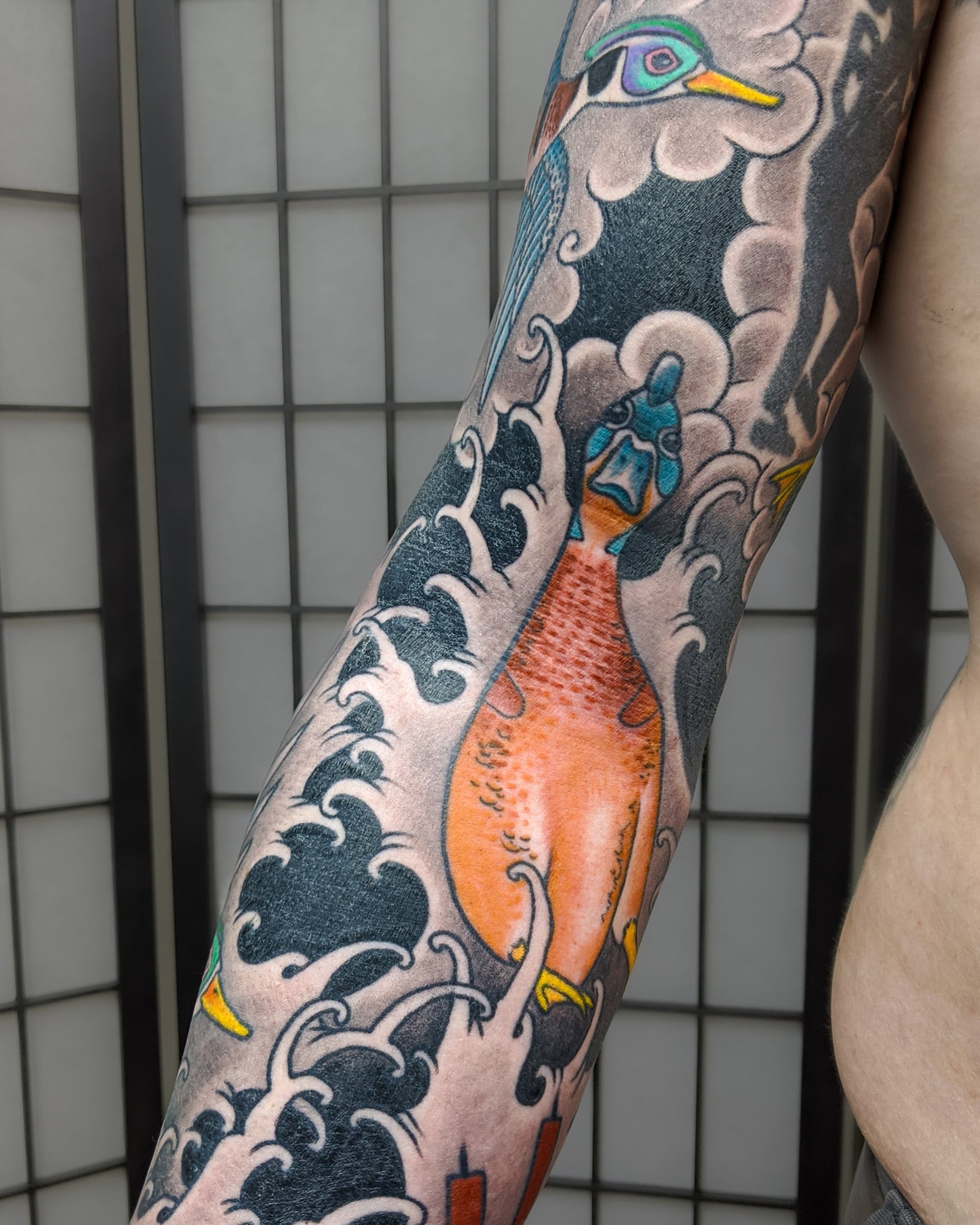
Japanese tattoo backgrounds are not extra. Waves, wind bars, clouds, rocks, and Mikiri are what make a Japanese tattoo read as one piece instead of a set of images sharing an arm. This is the question almost nobody knows to ask, and it’s the one that decides whether a large piece holds together.
I’ve spent 26 years building Japanese work from the Edo-period woodblock print tradition, and background is where that tradition is most specific and most misunderstood. If you’re planning a sleeve, a leg, or a back, read this before you settle on a subject.
The Background Is Part of the Tattoo
Subject, season, and setting
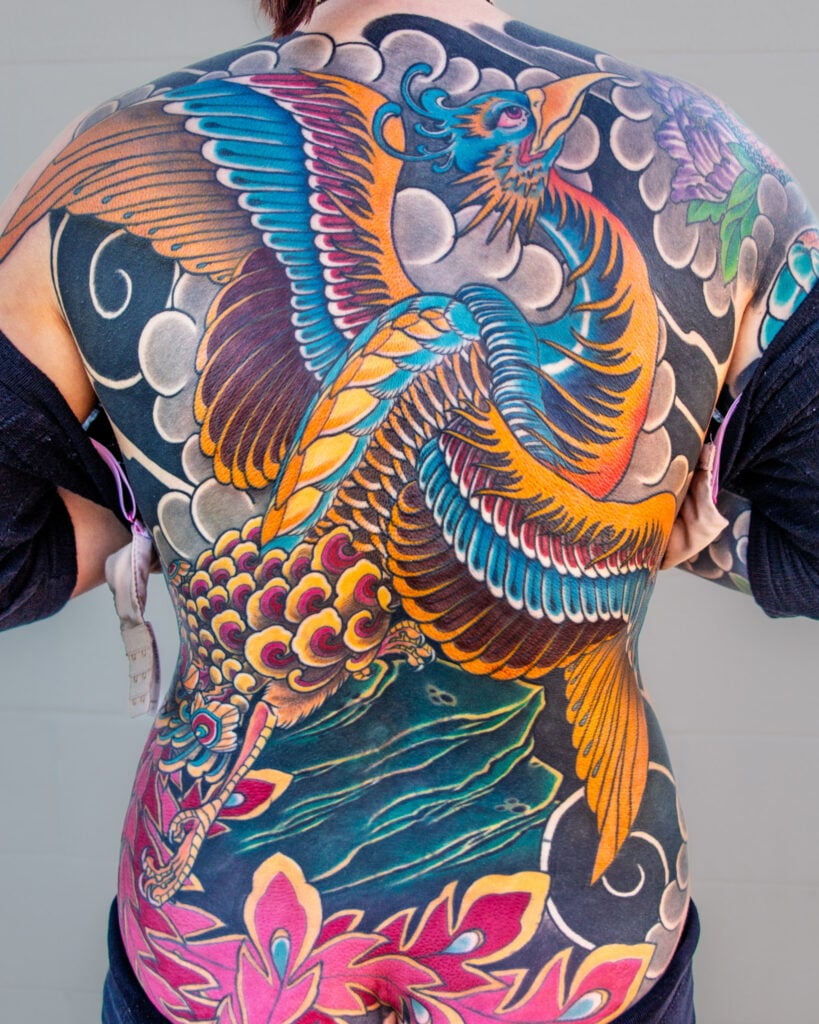
A Japanese composition has three things working: what the subject is, when it is, and where it is. Background carries the last two and it does it in the same pass as the first. Water and wind aren’t the space around the dragon. They’re the weather the dragon is in, and they’re the reason it reads as a force rather than a drawing.
Why isolated images do not read like Irezumi
Put a dragon on a bare arm and you have a picture of a dragon on an arm. Put the same dragon in clouds with a planned edge and you have Irezumi. Nothing about the animal changed. The difference is entirely structural: one has a world, the other is floating.
This is also what people are seeing when they look at a collection of separate tattoos next to a Japanese sleeve and can tell something is different without being able to name it. The name is background.
Water in Japanese Tattooing
Waves and waterfalls
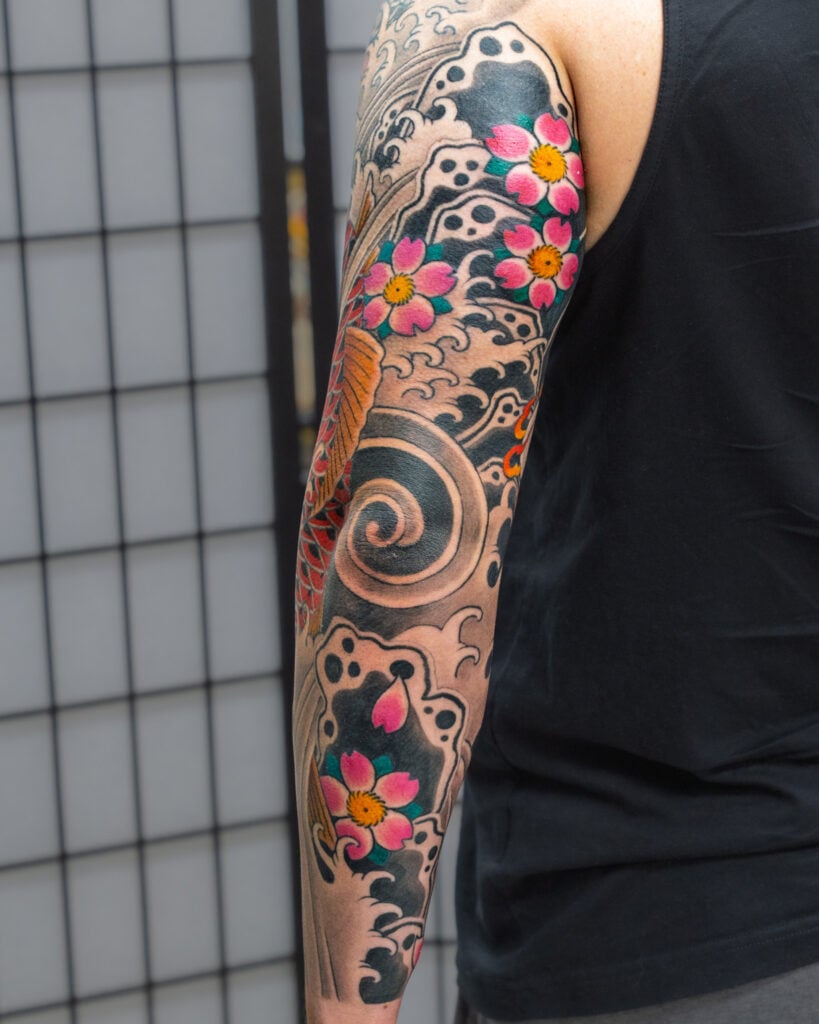
Waves are the most-used background element in the tradition and the most demanding to do well. They have a direction, a rhythm, and a scale relationship to the subject, and all three have to be decided rather than discovered. A waterfall gives you a vertical break and something for a subject to work against, which is why koi and waterfalls are directly tied.
Koi, dragons, lotus, and water subjects
Some subjects require water because they live in it. Koi, dragons, and lotus are all water subjects, and their meaning depends on the current. For a koi it’s literal: the direction of the water is the direction of the story. I go through that in the koi post.
Flow around the body
Water has to move around a limb the way water actually moves, which means the current gets planned in three dimensions, not on a flat drawing. A wave pattern that looks right on paper can go slack once it’s on an arm and the arm turns. Planning for the round surface is most of the skill.
Wind, Clouds, and Wind Bars
Tiger and dragon movement
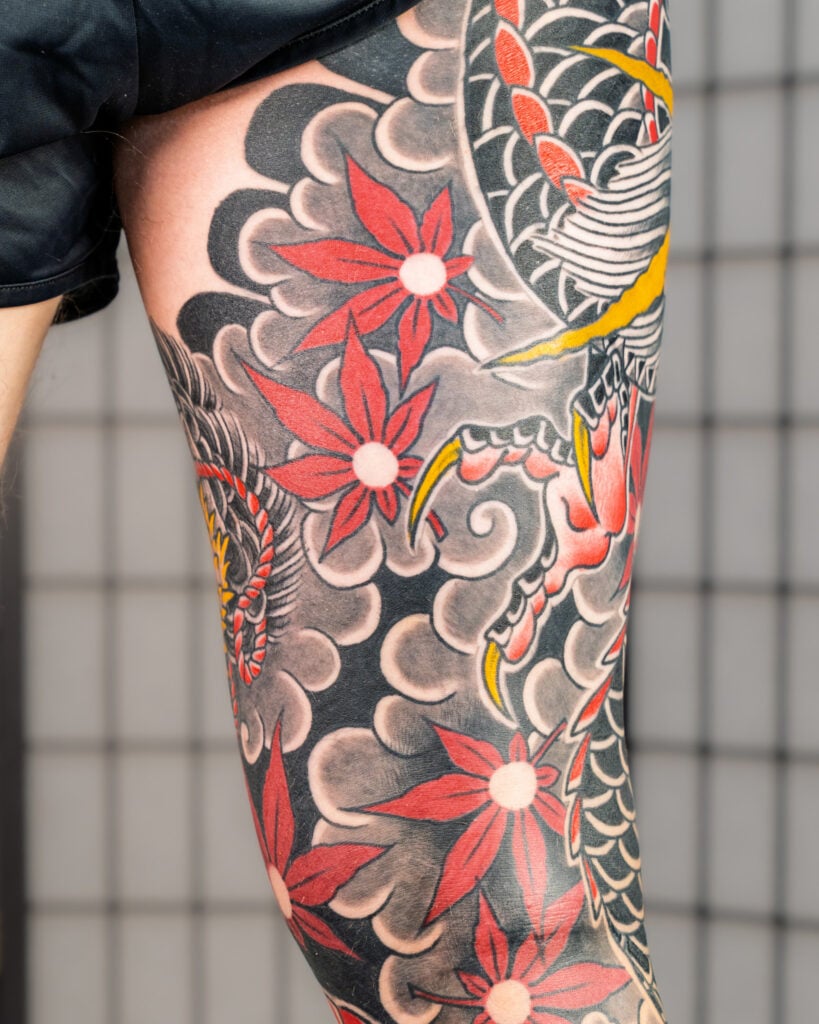
Clouds follow the dragon and wind follows the tiger. That isn’t just symbolism, it’s a working instruction: it tells you what element belongs with which animal and therefore what the background of that piece is going to be. See the tiger post for the pairing.
Sleeve direction and visual rhythm
Wind bars are the rhythm section. They run through a composition setting direction and pace, filling space with something that has motion in it. On a sleeve they’re what carries your eye from shoulder to wrist. Drawn right you barely notice them, which is exactly what they’re for.
Clouds around deities and mythological figures
Deities and mythological figures get clouds. Clouds put a figure in the sky, or somewhere that isn’t quite here, and they frame a face without crowding it. They also solve a practical problem, since a large figure leaves awkward space around it and clouds fill that space with something that belongs.
Mikiri and the Edge of the Composition
Framing the tattoo

Mikiri is the finished edge, where the background stops against bare skin. It’s a decision, and it’s the thing separating a Japanese piece from a tattoo that just trails off. The edge is designed with as much attention as the subject, because it’s the line everybody sees every time you wear a short sleeve.
How the edge affects future expansion
The edge also determines your options later. A Mikiri planned for a half sleeve that might become a full sleeve looks different from one meant to be final. Get this decided at layout and expansion is clean years later. Skip it and continuing the piece means reworking the seam, which costs sessions and never looks as good as planning it once.
Tell me at the start if a piece might grow. It costs nothing then and a lot later.
Planning Background Early
Outline, background, foreground sessions
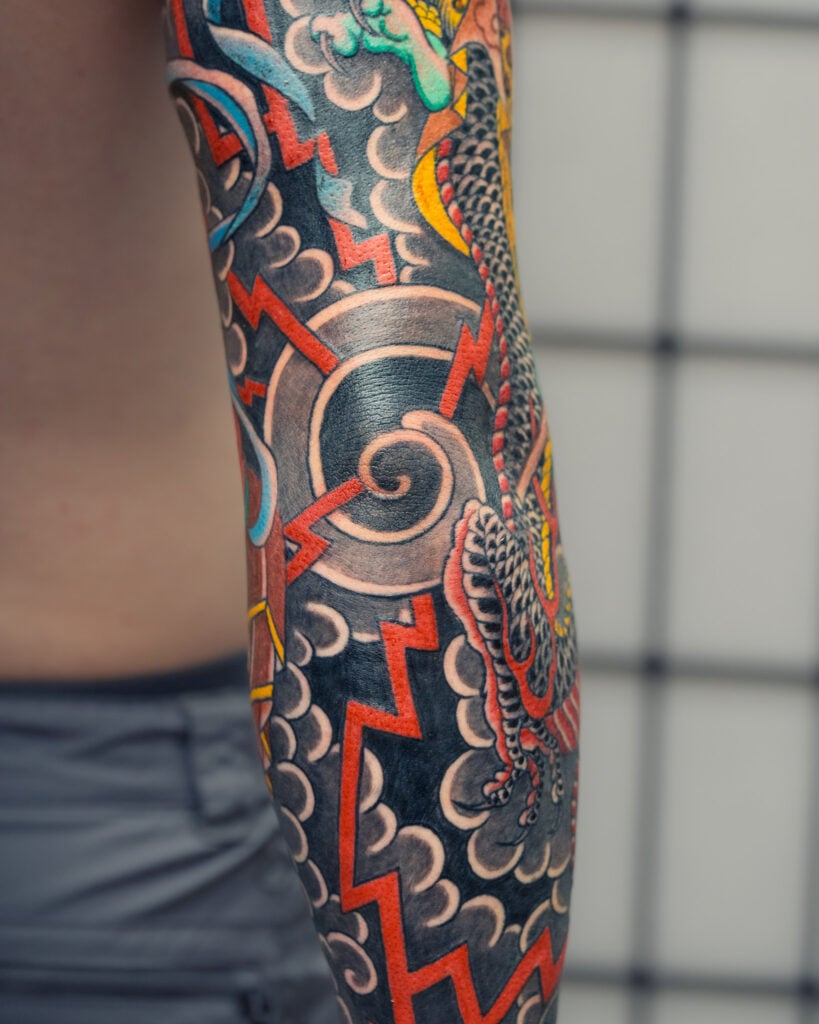
I work in sessions with clear goals: outline, background, foreground. That order is the reason the pieces hold together. The structure goes in before the detail, so by the time I’m doing foreground work every decision it depends on is already made and on the skin.
Why the background cannot be an afterthought
Background added later has to work around a subject that was drawn without it in mind, and it shows. The waves fit where there’s room instead of where they belong, the direction gets set by leftover space, and the edge lands wherever the drawing ran out.
It can be done, and I do it on existing work, but it’s a repair, not a plan. If you’re starting fresh, the background is part of the first drawing.
Background is also what has to agree across every section of a bodysuit, which is the whole reason a suit is planned before the first sleeve; the four large projects are laid out on the Japanese tattoos page. If you’re planning large-scale Japanese work, send a tattoo request and we’ll lay out the structure before anything gets drawn. Start with the meanings index for the subjects, read American Traditional vs Japanese Traditional for why these rules exist, and see my Japanese sleeve process for the sessions.
I tattoo at The Custom Tattoo Company in Havelock, NC, and see clients from Morehead City, Emerald Isle, and across Eastern NC. Japanese work gets priority booking.
Frequently asked questions
Why do Japanese tattoos have so much background?
Because the background is structure, not decoration. Waves, clouds, and wind bars set the season and the setting, control direction and rhythm, and tie the composition into one piece. Without them a subject floats on skin and reads as a picture on an arm rather than Irezumi. It’s the single biggest structural difference between Japanese work and a collection of separate tattoos.
What is Mikiri in Irezumi?
Mikiri is the finished edge of the composition, where the background stops against bare skin. It’s designed deliberately rather than left to trail off, and it’s what frames the tattoo. It also determines your options later, since an edge planned for possible expansion looks different from one meant to be final.
Can background be added later to an existing tattoo?
Yes, and I do it, but it’s a repair rather than a plan. Background added after the fact has to work around a subject drawn without it in mind, so the waves land where there’s room instead of where they belong and the direction gets set by leftover space. If you’re starting fresh, background belongs in the first drawing.
More subjects in the Japanese tattoo meanings index.
If this was useful, you can make davetedder.com a preferred source on Google. Your own search results will show this site more often.
Make davetedder.com a preferred source