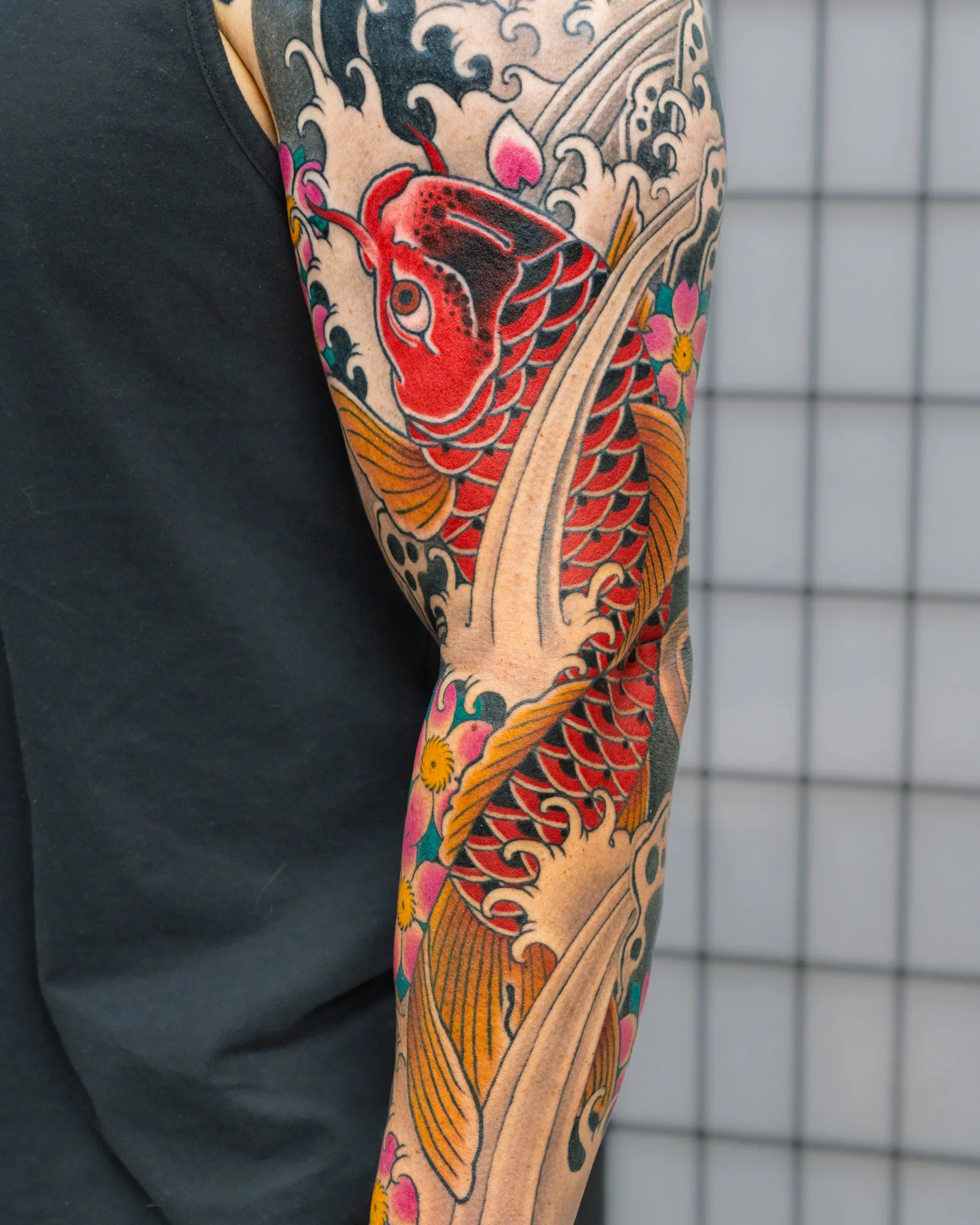
A Japanese koi tattoo means perseverance. What most people don’t know is that the meaning depends on which way it’s swimming, and that the water around it has to be planned to say the same thing. A koi fighting upstream and a koi drifting downstream are two different tattoos wearing the same fish.
I’ve been building large-scale Japanese work for 26 years, and koi are one of the subjects I recommend most often to someone starting their first serious piece. Here’s what the fish means, how direction changes it, and how the composition has to be laid out to support either reading.
What a Koi Represents in Japanese Tattooing
Perseverance and determination

The koi is the animal of sustained effort. Not a burst of strength, not luck. The kind of work that goes on for a long time against something that doesn’t let up. That’s the whole meaning, and it’s why the fish shows up so often on people who’ve been through something long.
The koi-to-dragon myth
The story comes from the Chinese legend of the Dragon Gate. Koi swim up the Yellow River against the current, and the one that makes it over the falls at the top transforms into a dragon. Effort rewarded with a change in kind, not just a change in position.
That’s the engine behind everything the koi carries. It also explains why koi and dragons belong in the same conversation, and why a composition can hold both. The dragon post picks up the other end of the story.
Upstream vs Downstream Koi
Ongoing struggle and ambition

A koi swimming upstream, against the current, is the fish in the middle of the fight. The goal is ahead and not yet reached. This is the reading most clients are after, and it’s the one that needs the strongest water to work, because struggle only shows if there’s something to struggle against.
Goals already reached
A koi swimming downstream, with the current, reads as arrival. The work is behind it. Some people want this and mean it. Others hear “downstream” as a lesser version and pick upstream by reflex. Neither is better. They’re different statements, and you should make the one you mean.
Why water direction has to be planned
Here’s the part that gets missed. The koi’s direction only means something relative to the current. If the waves are drawn without a decided direction, the fish isn’t swimming upstream or downstream. It’s just a fish in some water, and the meaning goes flat.
So the water gets planned first, at layout, along with the body placement. I decide where the current comes from, where it goes, and how it moves around the limb, and then the koi is placed into it. Do it the other way around and you spend the rest of the piece fighting your own background.
How Koi Work in Irezumi Composition
Half sleeves and forearms

A koi suits a half sleeve as well as any subject I work with. The body of the fish is a long curve, and the arm is a long curve, so the movement maps naturally from elbow to wrist or shoulder to elbow. It reads clearly at that scale without needing a full sleeve’s worth of space.
Backpieces and larger water scenes
At back scale you can build the actual scene: the falls, the rocks, the current, and the fish in relation to all of it. More than one koi becomes possible. So does showing the Dragon Gate story in full, with the change already underway at the top.
Waves, waterfalls, and rocks
Waves, waterfalls, and rocks are the koi’s world. The waterfall gives the fish something to climb. The rocks give the water something to break against. Together they set the direction the whole piece depends on. This is structural work, not filler, and I cover it in the water and wind post.
Seasonal Pairings for Koi
Maple leaves

Maple leaves put the koi in autumn. Falling leaves on moving water give you a second direction cue reinforcing the current, which is useful and also just true to how water works. It’s the rarer of the two seasonal choices, and I don’t get asked for it often, which is a little unfair to it.
Cherry blossoms
Cherry blossoms put the koi in spring and add impermanence to a subject that’s otherwise about endurance. The two ideas sitting together is the point. This is the koi pairing I do most, by a wide margin. See the cherry blossom post for how the flower behaves in a composition.
Peonies and other flowers
Peonies bring weight and good fortune, and they hold up next to a large fish without getting lost. Chrysanthemums put you in autumn with a different character than maple. The flower sets the season, so pick it for what the season says, not just the color.
Planning a Koi Tattoo That Fits the Body
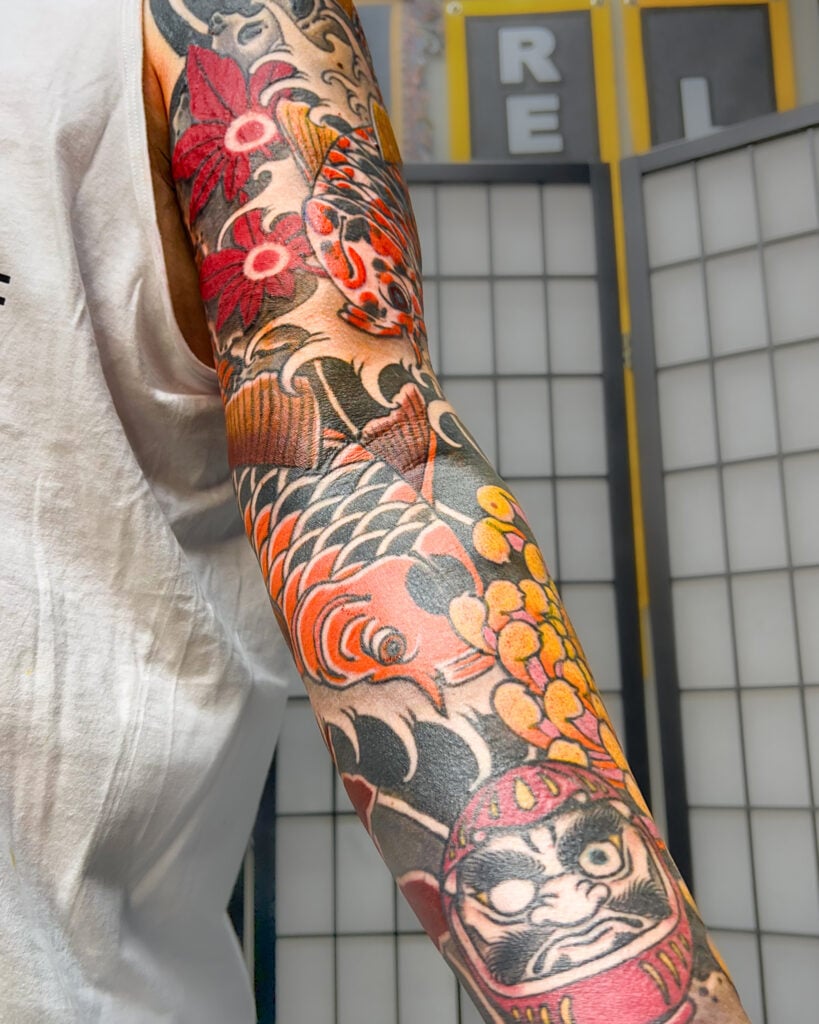
Koi are a good first large Japanese subject. Strong movement, clear symbolism, and they work at half sleeve scale, which means a real piece without committing to a full sleeve on day one.
I work in sessions with a clear goal each time: outline, background, foreground. You’ll know the session count and the cost per session before we start.
Koi are built for length, which is why they run so well on a Japanese sleeve or a leg sleeve with the water carrying them. Send a tattoo request and we’ll settle direction, scale, and season before anything gets drawn. The meanings index covers the other motifs, and my Japanese sleeve process walks through the sessions.
I tattoo in Havelock and see clients from New Bern, Beaufort, Swansboro, and across Eastern NC.
Frequently asked questions
Can a koi tattoo work as a half sleeve?
Yes, and it’s one of the subjects I recommend most for half sleeve work. The koi’s body is a long curve and so is the arm, so the movement follows the limb naturally from elbow to wrist or shoulder to elbow. You get a complete composition with real background at a scale that doesn’t require committing to a full sleeve.
What flowers pair well with a koi tattoo?
Cherry blossoms are the pairing I do most, setting the koi in spring and putting impermanence against the fish’s endurance. Maple leaves put it in autumn, and the falling leaves reinforce the water’s direction, though that one comes up rarely. Peonies bring weight and hold up next to a large fish. The flower sets the season, so choose it for what the season says rather than the color.
Does the water in a koi tattoo have to flow in a specific direction?
Yes, and it has to be decided before the fish is placed. A koi only reads as upstream or downstream relative to the current around it. If the waves are drawn without a committed direction, the symbolism goes flat and you have a fish in some water. I plan the current and the body placement first, then set the koi into it.
More subjects in the Japanese tattoo meanings index.
If this was useful, you can make davetedder.com a preferred source on Google. Your own search results will show this site more often.
Make davetedder.com a preferred source