
A Japanese dragon tattoo means water, wisdom, and protection. The dragon, ryu, is a guardian, not a monster. That single fact separates the Japanese dragon from almost every dragon a Western client has seen before, and it changes how the subject gets drawn, where it sits on the body, and what belongs around it.
I’ve been designing and tattooing Japanese Irezumi for 26 years, now at The Custom Tattoo Company in Havelock, NC, working from the Edo-period woodblock print tradition. The dragon is the subject I get asked about most. Here’s what it means and how I build one.
What a Japanese Dragon Represents
Water, wisdom, and protection
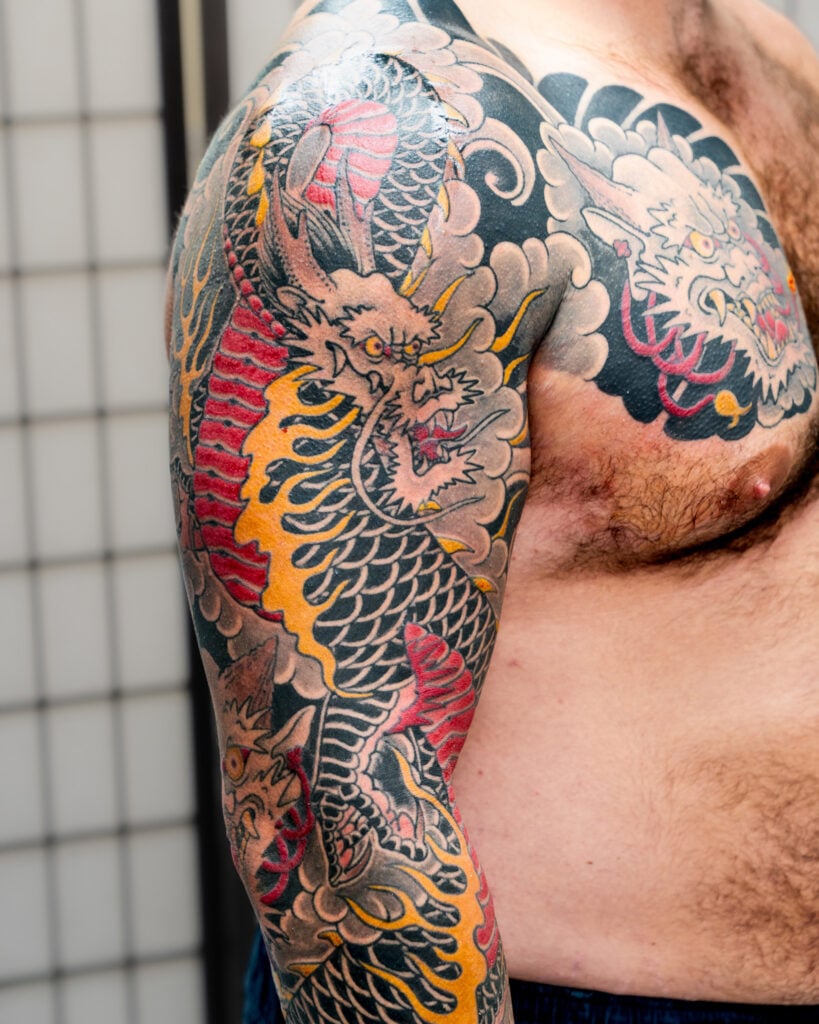
The ryu is a water creature. It lives in rivers, lakes, and the sea, and it moves between water and sky. Rain and storms follow it. That elemental association is the root of everything else the dragon carries: wisdom, because it is old and sees clearly, and protection, because a force that commands weather is a force you want on your side.
A dragon is a benevolent power in this tradition. It can be fierce. Fierce and evil are not the same thing. When a client tells me they want a dragon because it looks dangerous, I explain what they’re actually carrying, and most of the time the real meaning is closer to what they wanted anyway.
Why Japanese dragons are different from Western dragons
The Western dragon is a fire animal with wings, and the story usually ends with a knight killing it. The Japanese dragon has no wings and does not need them. It is serpentine, long-bodied, and it flies by moving the way a current moves. Its element is water, not fire. Nobody is coming to slay it.
That difference is structural, not decorative. A wingless serpentine body can wrap a limb. A winged, compact body cannot. The Japanese dragon is built to travel across a human body, which is exactly why the tradition put it at the center of large-scale work.
How Dragon Tattoos Are Composed
Wrapping the body through sleeves and legs

A dragon should move through a sleeve, not sit on it. I lay the body so it spirals with the arm, and I plan the turns so the piece reads from more than one angle. The head anchors the composition, usually at the shoulder or the outer forearm, and the body carries the eye through the rest of the arm. The tail resolves at a planned edge instead of stopping wherever the drawing ran out.
The same logic applies to a leg. A leg gives you length and a long clean spiral, and it hides less of the composition than people expect.
Backpiece scale and full-body movement
A back is where a dragon gets to be its full size. At that scale the whole animal can be present at once: head, body, claws, and tail, with room for a real setting around it. A backpiece can also extend into a bodysuit later if the edges are planned for it from the start.
Scale changes what the subject can say. A dragon on a back is a force in a world. A dragon crammed into a small panel is a picture of a dragon.
Clouds, waves, and wind bars
Clouds, waves, and wind bars are what make the dragon read as a dragon. They give it weather to move through and they tie the composition into one piece. Without them you have an animal floating on skin.
I use these elements to control the eye, to fill the space the subject does not occupy, and to unify a design that may run from shoulder to wrist. They also do the quiet structural work of holding the tattoo together as it ages. I go deeper on this in my post on water and wind backgrounds.
Traditional Pairings for Dragon Tattoos
Dragon and tiger
Dragon and tiger is the classic opposition: sky and earth, water and wind. The two balance each other, and in traditional composition they’re often placed on opposing sides of the body. It’s a pairing about equilibrium between two powers, not a fight with a winner. I cover the tiger’s side of it in the tiger post.
Dragon and koi
The dragon and the koi are the same story at two points in time. The koi that fights its way up the waterfall becomes a dragon. Putting both in one composition shows the effort and the result together, and it gives you a natural reason to build the whole piece around water. See the koi post for how that myth works.
Dragon with deities or mythological figures
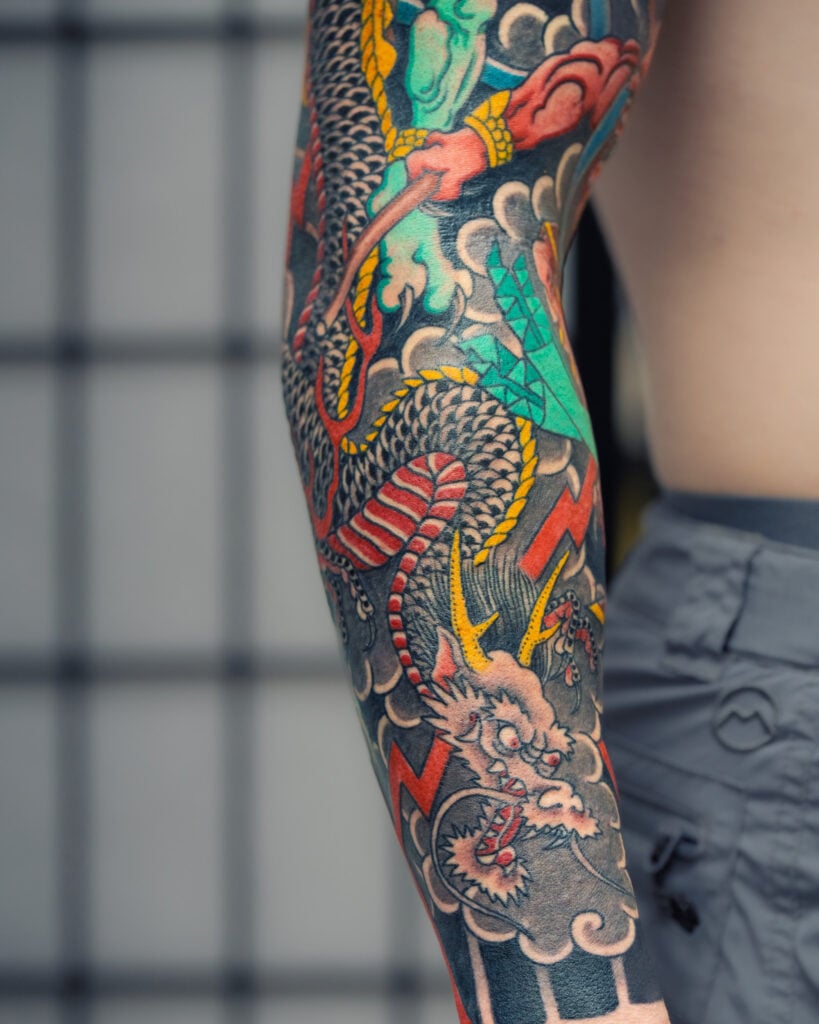
Dragons appear alongside deities, Suikoden heroes, and other mythological figures, usually as the elemental force the figure is contending with or commanding. These are the most demanding compositions I do. Two major subjects in one piece means both need room, and that decision has to be made at the layout stage, not halfway through.
Choosing Placement for a Dragon
Full sleeve
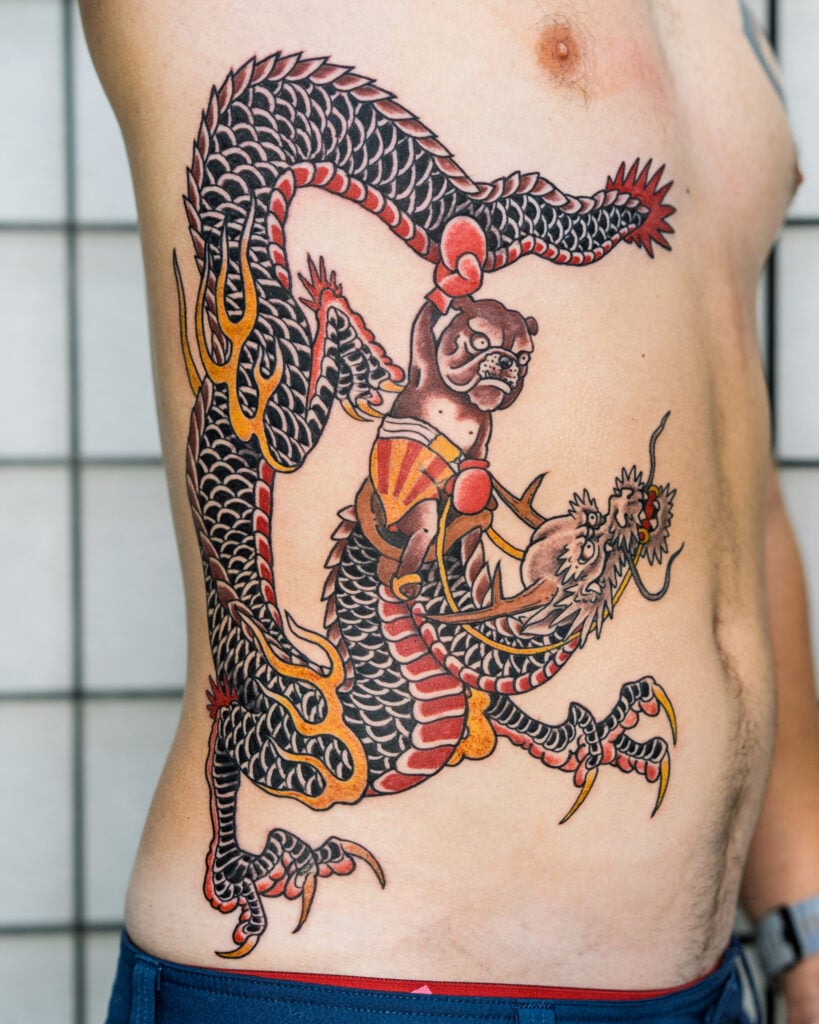
A full sleeve is the most common home for a dragon and the one I recommend most often for a first large Japanese piece. Shoulder to wrist gives the body enough length to move and enough space for real background.
Hikae and arm
A hikae carries the composition onto the chest panel and gives the dragon a wider field to turn through. It also sets up a larger project cleanly, whether or not you continue right away.
Leg sleeve or backpiece
A leg sleeve suits a dragon that’s mostly about movement. A backpiece suits a dragon that’s about presence. Both are multi-session projects, and both should be planned as complete compositions from the first drawing.
Planning a Dragon Tattoo With Dave

I work in sessions with a clear goal each time: outline, background, foreground. You’ll know the session count and the cost per session before we start. Japanese work gets priority booking.
A dragon is the subject I’m asked for most on a Japanese sleeve, and the one that earns its full length on a backpiece. If you’re considering a dragon, send a tattoo request and we’ll talk through placement, scale, and what belongs around it. Start with the meanings index if you’re still choosing a subject, and read how Japanese Traditional differs from American Traditional and my Japanese sleeve process for what the work involves.
I tattoo at The Custom Tattoo Company in Havelock, NC, and see clients from Swansboro, Emerald Isle, and across Eastern NC.
Frequently asked questions
What does a Japanese dragon tattoo mean?
A Japanese dragon, ryu, represents water, wisdom, and protection. It’s a guardian figure associated with rivers, rain, and sky, not a destructive monster like the Western dragon. Fierce and evil aren’t the same thing in this tradition, and the dragon sits firmly on the protective side.
Is a Japanese dragon tattoo better for a sleeve or a backpiece?
Both work, and they say different things. A sleeve suits a dragon that’s about movement, because the long serpentine body spirals naturally with the arm. A back gives you the whole animal at full scale with a real setting around it, and it can extend into a bodysuit later if the edges are planned for it. I’ll recommend one over the other based on your coverage goals and how much you want the piece to be a project.
Can a dragon be paired with a tiger or koi in the same tattoo?
Yes, and both pairings are traditional. Dragon and tiger balance sky against earth and water against wind, and they’re often placed on opposing sides of the body. Dragon and koi tell one story at two stages, since the koi that climbs the waterfall becomes a dragon. Either pairing needs to be decided at the layout stage, because two major subjects both need room.
More subjects in the Japanese tattoo meanings index.
If this was useful, you can make davetedder.com a preferred source on Google. Your own search results will show this site more often.
Make davetedder.com a preferred source