
A Japanese cherry blossom tattoo means beauty that doesn’t last. The blossoms bloom hard, they fall fast, and the falling is the part that matters. In Japanese tattooing they sometimes fill the space between the main subjects, but at their best they do more. Sakura sets the season, carries the mood, shows the direction of movement, and states a theme the main subject can’t state alone.
I’ve been building Japanese compositions for 26 years, and my fine art practice (silk-dye painting on paper) feeds straight into how I handle flowers. Blossoms are where a lot of Japanese work quietly succeeds or fails.
What Cherry Blossoms Represent
Brief life and beauty

The sakura’s meaning is in its schedule. It’s spectacular and then it’s over, and everyone watching knows the second part while they’re looking at the first. That’s the idea: beauty and its ending are the same event, not two.
Season and mood
Every flower in this tradition sets a season. Cherry blossoms mean spring, with everything spring implies about starting and not lasting. Maple leaves mean autumn. Chrysanthemums mean autumn with a different weight. Peonies bring fortune. Pick a flower and you’ve picked a time of year and a mood, whether you meant to or not.
Why the meaning matters in a tattoo
Because it changes what your main subject is saying. Blossoms against a warrior make a statement about mortality. The same blossoms against a koi make a statement about endurance measured against something brief. The flower isn’t neutral. It’s a comment on whatever it’s next to.
Cherry Blossoms as Part of a Larger Composition
Falling petals and motion
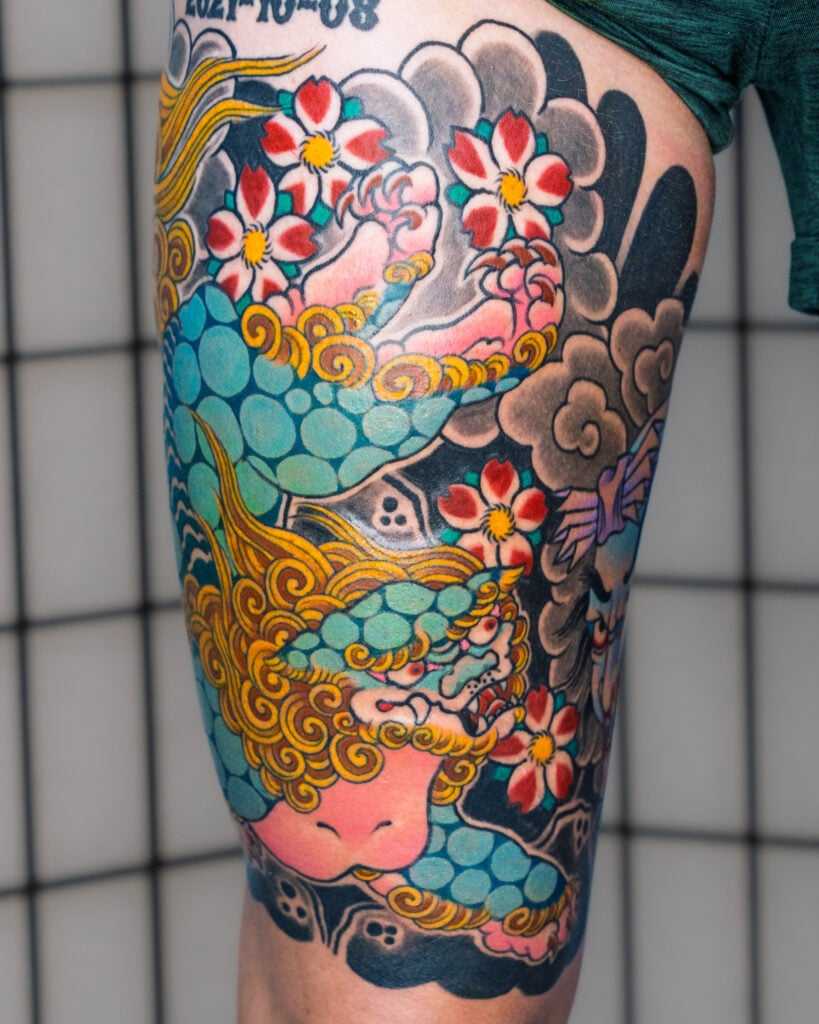
Falling petals are a direction tool. They show which way the air moves, and they carry the eye across gaps that would otherwise be dead. In a sleeve, petals can travel from shoulder to wrist and hold the whole thing together while barely being noticed. That’s them working.
Framing a main subject
Blossoms frame. Set around a mask or a figure, they close the space and push attention inward. Sized right they make the subject read bigger. Sized wrong they make it read smaller, which is the most common blossom mistake I see: petals so large and busy they compete with the thing they’re supposed to serve.
Supporting the background
Blossoms sit between the subject and the background. They carry more visual weight than wind bars and less than the main motif, and used well they cover that middle ground so a composition doesn’t jump straight from a strong subject to empty space.
Common Cherry Blossom Pairings
Hannya masks

Blossoms with a Hannya put fleeting beauty against consuming emotion. It’s the pairing that gives the mask air around it without softening what it means. See the Hannya post for how the mask reads.
Koi and water
Blossoms on water set the koi in spring and give the current a second direction cue, since petals ride the water the way leaves do. Endurance against something brief, which is the tension worth building the piece on. The koi post covers the water planning.
Cranes and clouds
Cranes bring longevity and calm, and blossoms bring the opposite. A thousand years next to a week. It’s a quiet composition and one of my favorites to draw, because everything in it is doing something and nothing is loud.
Samurai and mortality themes
This is the oldest use and the most direct. Blossoms falling around a warrior is a statement about a life that’s meant to be spent. It’s the pairing where the flower is doing the most work and where getting the petal scale right matters most.
Choosing Seasonal Elements
Cherry blossoms vs maple leaves

Both fall. Both carry motion. They say different things. Blossoms are spring and brevity, and they read light and dispersed. Maple is autumn and endings that come after a full run, and it reads heavier with more color mass. Against a koi, blossoms give you tension and maple gives you agreement. Neither is right by default.
Matching the subject, not just the color
Most people pick blossoms because pink looks good next to what they’ve already chosen. That’s a real consideration and it’s the last one, not the first. Pick the season that matches what the piece is about, then handle the color inside that choice. A composition where the season contradicts the subject looks fine on day one and never quite adds up afterward.
Planning a Japanese Tattoo With Floral Elements
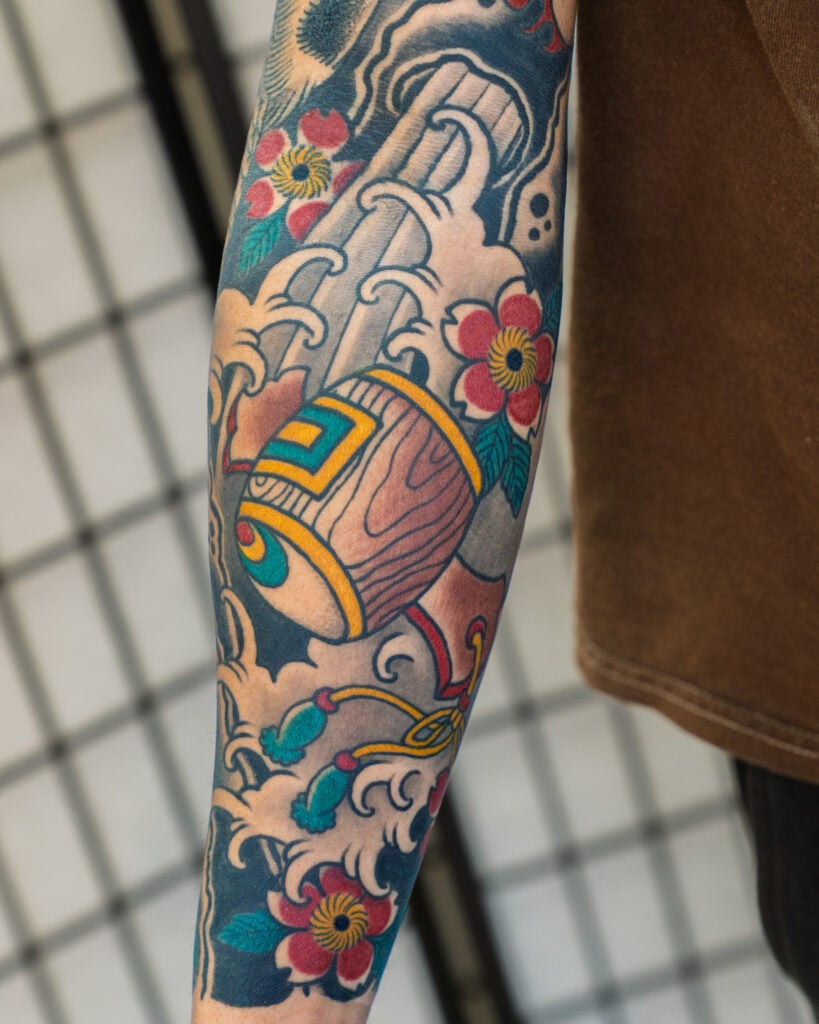
Blossoms get planned at layout with everything else. They’re not something added at the end to fill space, and a piece designed without them doesn’t get better by having them dropped in later.
I design complete compositions rather than isolated images, and I work in sessions with a clear goal each time: outline, background, foreground.
Cherry blossoms are background, so they belong to whatever carries them, most often a Japanese sleeve. Send a tattoo request and we’ll settle the season along with the subject. The meanings index covers the other motifs, and my Japanese sleeve process walks through how the sessions run.
I tattoo in Havelock and see clients from New Bern, Beaufort, Greenville, and across Eastern NC.
Frequently asked questions
What do cherry blossoms mean in Japanese tattooing?
They represent beauty that doesn’t last. The blossom is spectacular and then it’s over quickly, and the falling is as much of the meaning as the bloom. They also set the season to spring, which colors whatever subject they’re placed against.
Can cherry blossoms be the main subject of a tattoo?
They can, though it’s uncommon in traditional Japanese work, where blossoms usually comment on a main subject rather than carry the piece alone. A composition built primarily on blossoms needs something structural to hold it, usually branches, water, or wind, or it reads as pattern instead of a scene. I’d want to talk through what you want it to say before building one that way.
What motifs pair well with cherry blossoms?
Hannya masks, setting fleeting beauty against consuming emotion. Koi, where petals ride the current and put endurance next to brevity. Cranes, pairing a thousand years of longevity against a week of bloom. Samurai figures, the oldest pairing and the most direct statement about mortality. In each case the flower is commenting on the subject, so the pairing should be chosen for what it says.
More subjects in the Japanese tattoo meanings index.
If this was useful, you can make davetedder.com a preferred source on Google. Your own search results will show this site more often.
Make davetedder.com a preferred source