A full Japanese sleeve tattoo usually takes 3 dedicated sessions, spread over 2 to 4 months depending on the complexity of the design and healing time between sessions. I’ve been doing large-scale Japanese Irezumi work since 2000, now at The Custom Tattoo Company in Havelock, NC, and the session count stays remarkably consistent because the process is built around a traditional structure that works.
Here’s how it breaks down from start to finish.
It Starts With a Consultation
The process starts with a consultation, not a needle. We talk about your idea, the subject you are drawn to, the placement, and how much of the arm you want to cover. I will ask questions that might seem indirect: what the piece means to you, what you want it to feel like, whether you are open to traditional subjects that suit your idea better than the first thing you had in mind. That conversation shapes the design. Japanese tattooing has real rules about which subjects pair with which backgrounds and how a composition should flow, and part of my job is guiding your idea toward something that will sit well on your body and honor the tradition it comes from.
From there comes design. Large Japanese work is drawn to your specific arm, which means the design is built around the shape of your muscle, the way your arm moves, and how the piece reads from every angle. This is not a flash sheet you point at. It is a custom composition, and getting it right before we start is what separates a sleeve that flows from one that fights the body.
How Sessions Work
Every large-scale Japanese tattoo follows the same three-phase structure: outline, background, foreground.
The first session is the outline. This is the skeleton of the entire piece, the line drawing that maps every element onto the body. Dragons, koi, figures, waves, clouds, everything gets placed in relation to everything else. In Japanese tattooing, the composition is designed as a unified whole, not a collection of separate images. The outline session establishes that structure.
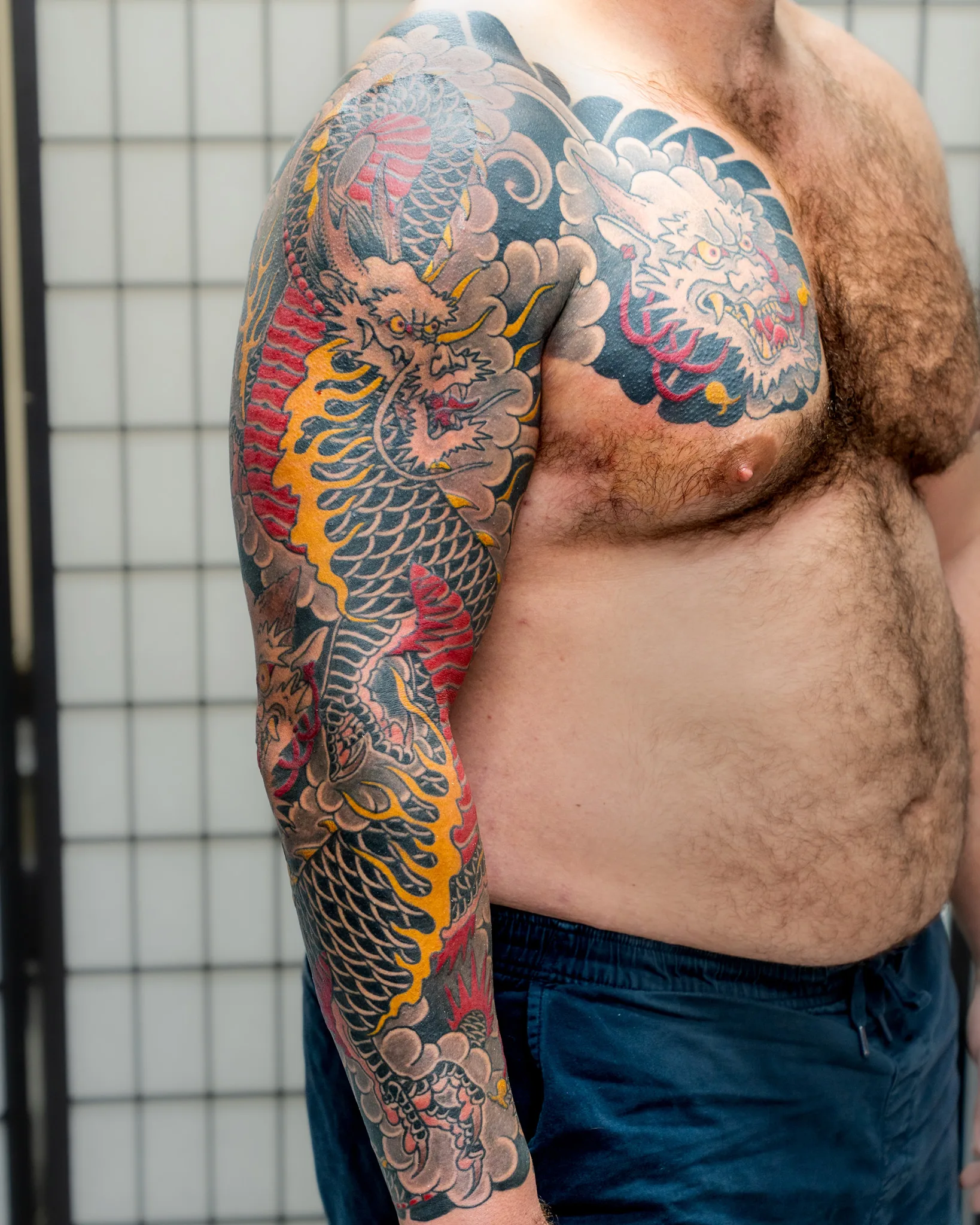
After the outline heals (usually 2 to 3 weeks), we move into background. This means the wind bars, waves, clouds, rocks, and water that fill the spaces between the main subjects. Background is what separates Japanese work from most Western tattooing. It’s what makes a sleeve read as one piece instead of a patchwork of individual tattoos. This typically takes 1 to 2 sessions depending on coverage.
The final phase is foreground: filling in the main subjects with color, shading, and detail. Foreground work brings the composition to life. Depending on how many major elements are in the design, this takes 1 to 2 sessions.
Timeline for Different Project Types
Not every project is a full sleeve. Here’s a general breakdown of what different coverage levels require:

Half sleeve (shoulder to elbow or elbow to wrist): usually 2 sessions, typically completed in 6 to 10 weeks. This is a good starting point for people new to large-scale Japanese work.
Full arm sleeve (shoulder to wrist): usually 3 sessions, over 2 to 4 months. The most common large-scale project I do.
Leg sleeve (hip to ankle): usually 5 sessions. Legs have more surface area than arms, and the calf and shin require careful placement to work with the muscle structure.
Backpiece: usually 4 sessions, sometimes more depending on how much detail goes into the composition. A full back is the largest single canvas on the body, and it’s where Japanese tattooing operates at its most complete.
Bodysuit (Donburi, Munewari, or similar coverage): This is a multi-year commitment measured in dozens of sessions. Bodysuits are planned as a total composition from the start, even if they’re built in stages over time.
These numbers assume full-day sessions. They only run longer when somebody cannot sit for a full day, and those are the outliers. I don’t do short appointments for large-scale work. Each session has a specific goal, and we work until that goal is met.
What It Costs
Now the money, out in the open. I publish a full price guide so you can see real numbers before you ever send a message. A Japanese arm sleeve at my studio in Havelock, North Carolina, runs about three sessions per arm, with a typical range of $3,000 to $4,500 per arm. If the piece carries onto the chest panel, plan on four to five sessions per side in the $3,500 to $5,200 range. A deposit of $300 holds your project and starts the design work, and you pay per session as the work progresses. I use traditional Japanese body coverage terminology (Nagasode, Hikae, Munewari) to define the scope of each project, which keeps the pricing structured and predictable. These are ranges rather than one flat quote, because the final figure depends on the design, the placement, the scale, and any existing work we build around. You can see the whole guide, including larger projects like leg sleeves and full bodysuits, on the price guide.
During the consultation I give you a straight estimate of your likely session count and total, so you can plan for the real commitment. And if someone quotes you a suspiciously low flat rate for a full custom sleeve, that usually means corners on the work or a surprise waiting later. Honest pricing on large work is a clear range and a steady rhythm, not a magic figure.
What I Need From You
What the shop needs from you is straightforward, and it matters. Show up on schedule, because a project that stalls between sessions loses momentum and pushes your finish date out. Follow aftercare between sittings so each stage heals clean and the next session starts on good skin. Eat and hydrate before a long session so your body handles it well. And come in with patience. The best Japanese work is a partnership that plays out over months, and the clients who enjoy the process are the ones who settle into that pace rather than counting down to the end.
Starting a Project
The first step is a tattoo request form or a phone call. Tell me what you’re thinking, where it goes, and how much coverage you want. I’ll follow up to discuss the concept, answer questions, and schedule a consultation.
For local clients near Havelock, New Bern, or Morehead City, the consultation is in person at the shop. For clients traveling from Greenville, Jacksonville, or further out, phone or video consultations work fine for the initial planning.
Japanese work gets priority booking. Once the plan is set, I’ll schedule your sessions and we start building.
For booking information or to submit a request please visit the links below
Common Questions
How long does it take to get a full Japanese sleeve tattoo?
A full arm sleeve usually takes 3 sessions spread over 2 to 4 months. Each session follows the traditional structure: outline first, then background, then foreground. The exact timeline depends on design complexity and healing time between sessions.
Can I start with a half sleeve and extend it later?
Yes, and I plan for that when it’s the intent. If there’s a chance you’ll want to extend to a full sleeve later, I design the initial half sleeve with that expansion in mind so the composition flows naturally when we add to it. It’s always better to discuss the long-term plan upfront.
Do I need to sit for the whole session, or can we take breaks?
We take breaks as needed. Large-scale sessions are full-day commitments, but that doesn’t mean continuous tattooing. Breaks for food, stretching, and rest are built into the day. I work efficiently, but I don’t push through discomfort just to save time.
If this was useful, you can make davetedder.com a preferred source on Google. Your own search results will show this site more often.
Make davetedder.com a preferred source