American Traditional and Japanese Traditional tattoos are two different approaches to the same medium. The difference isn’t just subject matter (anchors vs. dragons). It’s how the work is designed, how it relates to the body, and what holds the composition together. Japanese Traditional has its own name, Irezumi, and that’s the word I’ll use for it below. I specialize in large-scale Japanese work and still tattoo American Traditional by request, and after 26 years of doing both I can tell you the distinctions run deep.
Here’s what actually separates them.
The Body as a Canvas
The biggest difference is how each tradition treats the body.
In American Traditional, as in most Western tattooing, each tattoo is an independent piece. You get an eagle on your chest, a rose on your forearm, a skull on your calf. Each one is designed on its own, placed on its own, and doesn’t necessarily relate to anything around it. Over time, you might fill in gaps, but the overall effect is a collection of individual images.
Japanese Irezumi starts from the opposite end. The body is treated as a single surface, and the composition is designed to flow across it as one unified piece. A sleeve isn’t five separate tattoos arranged on an arm. It’s one composition that wraps the entire limb, with every element placed in relationship to every other element. Subjects, background, and negative space all work together.
This is why Japanese tattoo artists plan large. Even a half sleeve is designed with the full arm in mind. Even a chest panel is designed knowing what the back and arms might eventually become.
Background and Negative Space
This is where the traditions diverge most clearly.
American Traditional usually leaves the background out. A rose sits on skin. An eagle sits on skin. The untouched skin between pieces is just that, untouched skin. Some modern Western styles have incorporated background elements, but it’s not foundational to the tradition.
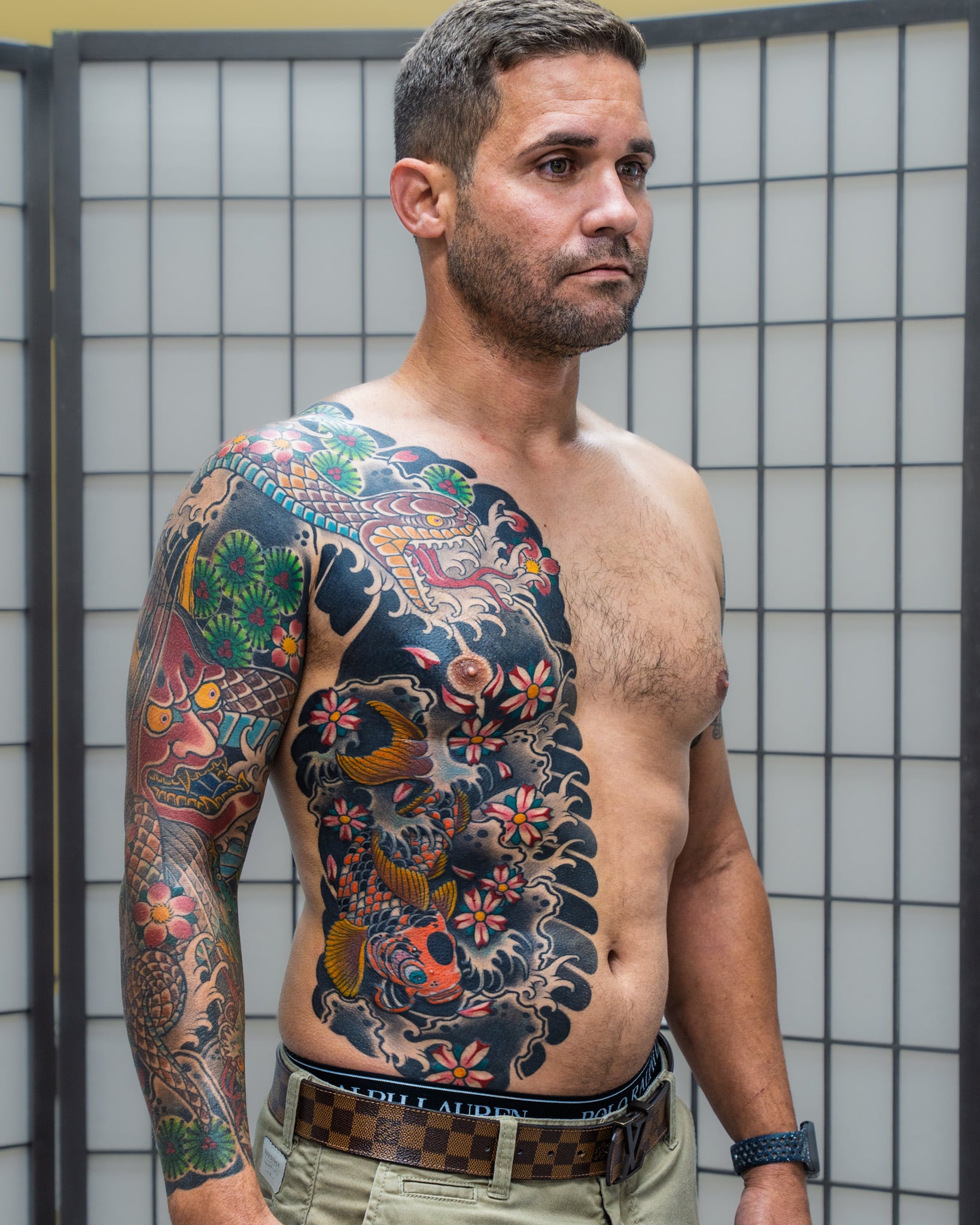
In Japanese work, background is mandatory for large-scale compositions. It’s called Gakubori, the system of background elements that fills the space between subjects and connects everything visually. Waves, wind bars, clouds, rocks, waterfalls, and smoke are the standard vocabulary. These aren’t decorative filler. They create depth, movement, and atmosphere. They’re also what makes a Japanese sleeve read as a single coherent piece from across a room.
I spend as much time planning and executing background as I do on the main subjects. It’s not an afterthought. It’s half the work.
Subject Matter and Visual Language
Both traditions draw from specific visual vocabularies, but the sources are very different.
American Traditional pulls from Western folk imagery, military culture, and maritime life. Eagles, ships, daggers, snakes, skulls, pin-ups, hearts. The imagery is bold, direct, and symbolic in a Western sense. A ship means something. An eagle means something. The meanings are generally straightforward.
Japanese Irezumi pulls from Edo-period woodblock prints, Buddhist and Shinto mythology, classical literature, and nature. Dragons, koi, Hannya masks, tigers, mythological heroes like Kintaro and Bishamonten, and yokai (Japanese spirits and demons). The visual language is layered. A koi swimming upstream means something. A dragon paired with a tiger means something. A cherry blossom has specific connotations about impermanence. The symbolism is rooted in centuries of Japanese art history.
I draw directly from the woodblock print masters: Kuniyoshi, Yoshitoshi, Kunisada. The subjects in my Japanese work aren’t invented. They’re inherited from a tradition that’s hundreds of years old, adapted to work on skin.
Technical Approach
Both styles share a commitment to bold outlines and saturated color. But the execution differs.
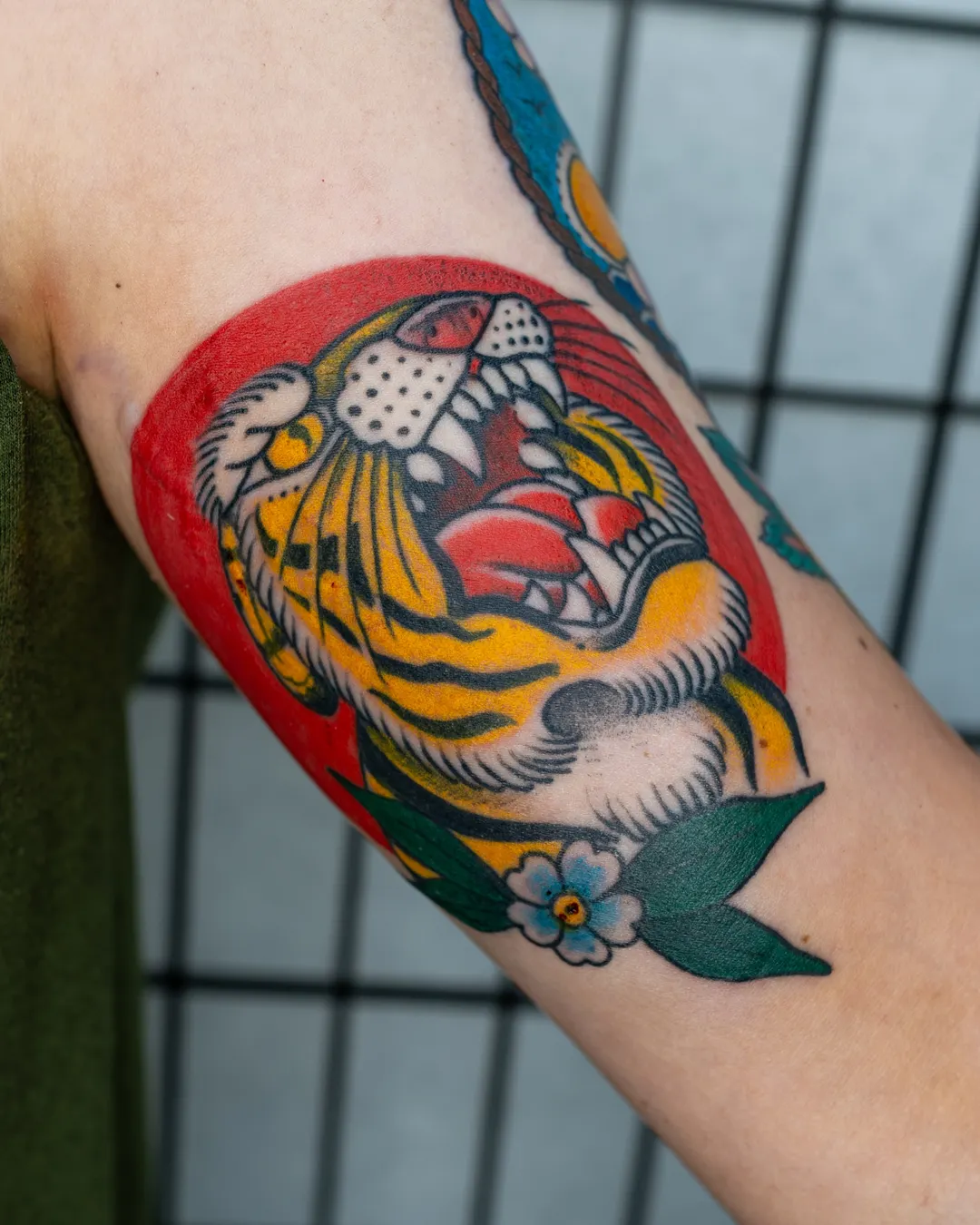
American Traditional uses a limited color palette: red, green, yellow, blue, black. The shapes are flat and graphic. Shading is minimal and serves the bold outline. The whole point is clarity and impact, designs that read at a distance and hold up over decades.
Japanese work uses a wider color range but follows its own rules. Color gradients are more common. Shading follows the form of the body. The interplay between foreground subjects and background elements creates depth that American Traditional doesn’t aim for. Both styles are built on the same principle (bold lines, strong color, longevity), but they apply that principle differently.
Traditional Irezumi vs. Modern Japanese-Style Tattoos
There’s a difference between traditional Irezumi and what most shops now call modern Japanese-style, or neo-Japanese, tattooing. The modern version borrows the imagery, dragons, koi, waves, Hannya masks, but often drops the rules that hold a traditional composition together. You’ll see single elements treated as standalone pieces, Western-style shading, or backgrounds left out entirely. It can look good, but it’s a different thing.
I work in the traditional structure. That means classical motifs drawn from the woodblock masters, Gakubori background that connects the whole piece, and a composition planned across the body rather than placed one tattoo at a time. The imagery and the rules come from the same source, and I keep them together.
Why It Matters When Choosing Work
Understanding these differences matters if you’re considering a large-scale project. Japanese Irezumi requires commitment to the composition, the process (multiple sessions, planned in advance), and the scale. It’s not something you can build piecemeal the way you might collect individual American Traditional pieces over time. For more on how the session structure works, see my post on how a Japanese sleeve tattoo works.
That said, both traditions age well when done correctly. Bold lines and saturated color hold up. That’s the common ground, and it’s the standard I hold both to.
If you’re interested in Japanese work, I do this at The Custom Tattoo Company in Havelock, NC, serving clients from across Eastern North Carolina including Jacksonville, Greenville, New Bern, and the Crystal Coast. The first step is a tattoo request to start the conversation.
For booking information or to submit a request please visit the links below
Common Questions
What is Irezumi?
Irezumi is the traditional Japanese style of tattooing that treats the body as a unified canvas. It uses background elements like waves, clouds, and wind bars to connect subjects into complete compositions. The tradition draws from Edo-period woodblock prints, Japanese mythology, and classical literature. It’s structurally different from American Traditional and most Western tattooing, which treat each tattoo as an independent image.
Can you combine Japanese and American Traditional styles in one tattoo?
They’re separate traditions with different rules, and I keep them that way. I wouldn’t put American Traditional lettering inside a Japanese sleeve, for example. That said, many of my clients have both styles on different parts of their body. A Japanese sleeve on one arm and American Traditional pieces on the other is common, especially among military clients who appreciate both traditions.
Is Japanese tattooing more painful than other styles?
The pain level depends more on placement and session length than on the style. Japanese work tends to involve longer sessions and more coverage per session, which means more cumulative time under the needle. But the needle itself doesn’t hurt more because it’s drawing a dragon instead of an eagle. Placement is what matters: ribs, inner arm, and kneecap are going to be sensitive regardless of what’s being tattooed there.
If this was useful, you can make davetedder.com a preferred source on Google. Your own search results will show this site more often.
Make davetedder.com a preferred source